


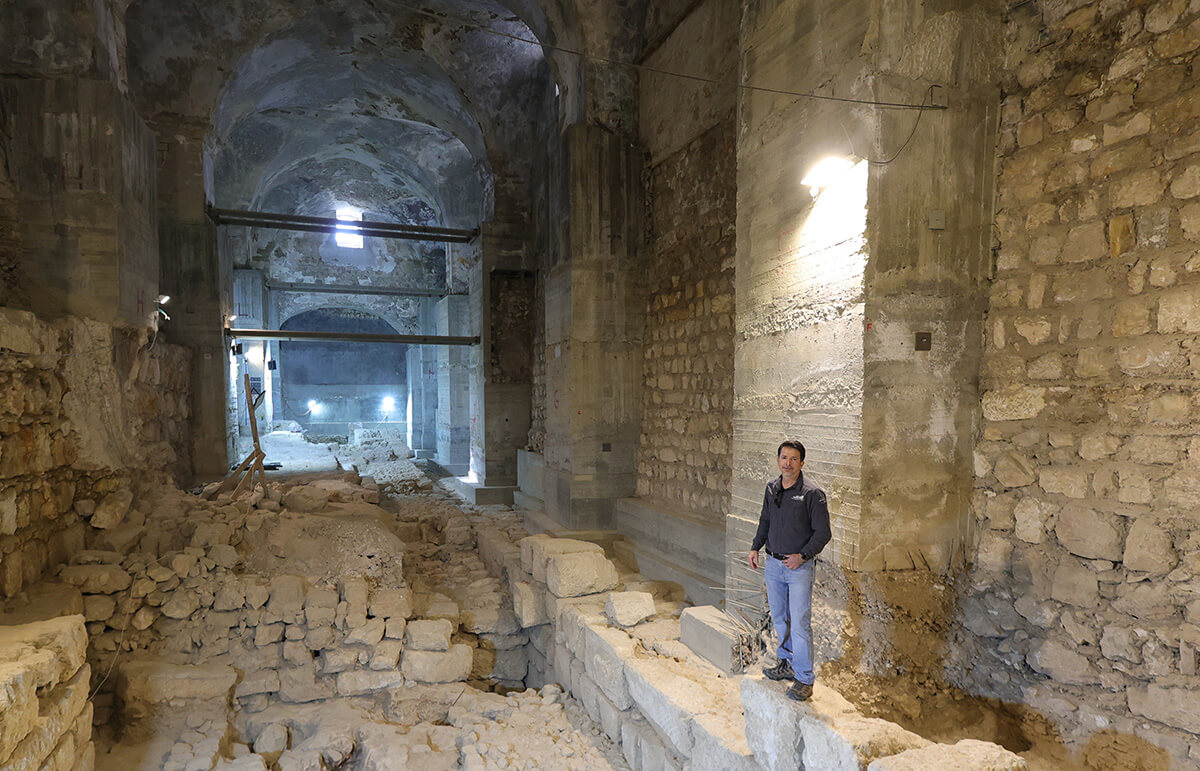
Beneath the familiar stones of Jerusalem’s Old City, history has revealed itself once again. During preparations for a new wing at the Tower of David Jerusalem Museum, archaeologists from the Israel Antiquities Authority uncovered an extraordinary section of a Hasmonean-era fortification wall. Built in the late second century BCE, when Jewish self-rule was restored after the victory of the Maccabees remembered at Hanukkah, this massive structure is one of the longest and best-preserved sections of Jerusalem’s ancient city wall ever discovered.
A Mighty Wall with an Inconvenient Ending
The wall was discovered in the historic Kishle complex, a former Ottoman and British-era prison within the Tower of David grounds, where no one less than Ze’ev Jabotinsky was once imprisoned. Measuring more than 40 meters in length and around five meters in width, it was constructed from enormous, carefully dressed stones. Archaeologists believe it originally rose to over ten meters high, making it even more imposing than the walls that surround the Old City today.
Yet what makes the discovery especially intriguing is not only the wall’s size, but its fate. The remains show clear evidence of deliberate, systematic destruction. This was no slow collapse caused by time or a single violent assault. Instead, the wall was carefully dismantled down to its base, leaving only a stump behind.

Antiochuses by the Sackful
One possibility leads back to a dramatic chapter after the Hanukkah story, when Jerusalem found itself facing yet another Antiochus. Around 134 BCE, the Seleucid ruler Antiochus VII Sidetes laid siege to the city. According to the first-century Jewish historian Flavius Josephus, the Hasmonean leader John Hyrcanus I agreed to dismantle Jerusalem’s fortifications as part of a peace settlement, even paying an enormous tribute taken from King David’s tomb.
Echoes of that confrontation were found nearby. Earlier excavations uncovered hundreds of catapult stones, arrowheads, slingstones, and lead sling bullets, silent reminders of Antiochus’s year-long siege of Jerusalem. Some of these weapons are now on display at the museum, allowing visitors to come face to face with the city’s turbulent past.
Josephus writes, “He broke down the fortifications that encompassed the city. And upon these conditions Antiochus broke up the siege and departed.” One reason John Hyrcanus may have agreed to Antiochus VII’s terms lies in the ruler’s very different approach to Jewish tradition. Unlike Antiochus IV Epiphanes of the Hanukkah story, who openly defiled the Temple and brutally suppressed Jewish life, Antiochus VII showed a measure of respect for religious practice. During the siege, he even granted a seven-day truce to allow Jerusalem’s residents to observe the festival of Sukkot, earning a reputation for piety.
Herod, the great builder and destroyer?
Another theory points to King Herod the Great, who ruled a century later. Herod built his grand palace directly over the remains of the Hasmonean wall, burying it deep within its foundations. Archaeologists suggest this demolition may have been a calculated political act, erasing the physical symbols of Hasmonean rule to assert his own authority over Jerusalem.

Josephus described Herod’s palace as so vast that generations of historians suspected he might be exaggerating once again. That doubt began to fade with discoveries in the Kishle, where archaeologists uncovered the palace’s massive foundations. Herod employed a bold engineering strategy, building massive retaining walls and filling the space between them to create an artificial, level platform. Using the same technique as at the Temple Mount, he overcame Jerusalem’s uneven terrain and extended his palace complex south toward Mount Zion.
Step into the story
Soon, the newly uncovered wall itself will become part of the visitor experience. In the new Schulich Wing of Archaeology, Art and Innovation, guests will walk on a transparent floor above the ancient stones, while contemporary artworks offer fresh perspectives on Jerusalem’s layered history.
The Kishle complex is part of the Tower of David Jerusalem Museum, which features newly renovated, state-of-the-art galleries that combine innovative technology with storytelling to explore the city’s history across thousands of years.

Fun Fact: What’s in a Nose?
The so-called “bust of Josephus” in fact has no name, but a text by the church father Eusebius mentions that Josephus was once honored with a statue in Rome. In 1930, art historian Robert Eisler, himself of Jewish descent, took this anonymous Roman face to be Josephus, largely because it looked “Jewish.” The idea stuck, and the bust went on to star in countless books and illustrations about Flavius Josephus. It even still appears on his Norwegian Wikipedia page, although scholars today reject the identification and the museum in Copenhagen correctly labels it a “portrait of an unknown Roman man,” and rightly so.