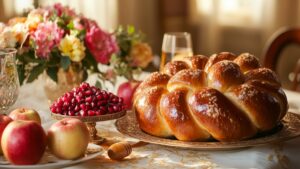

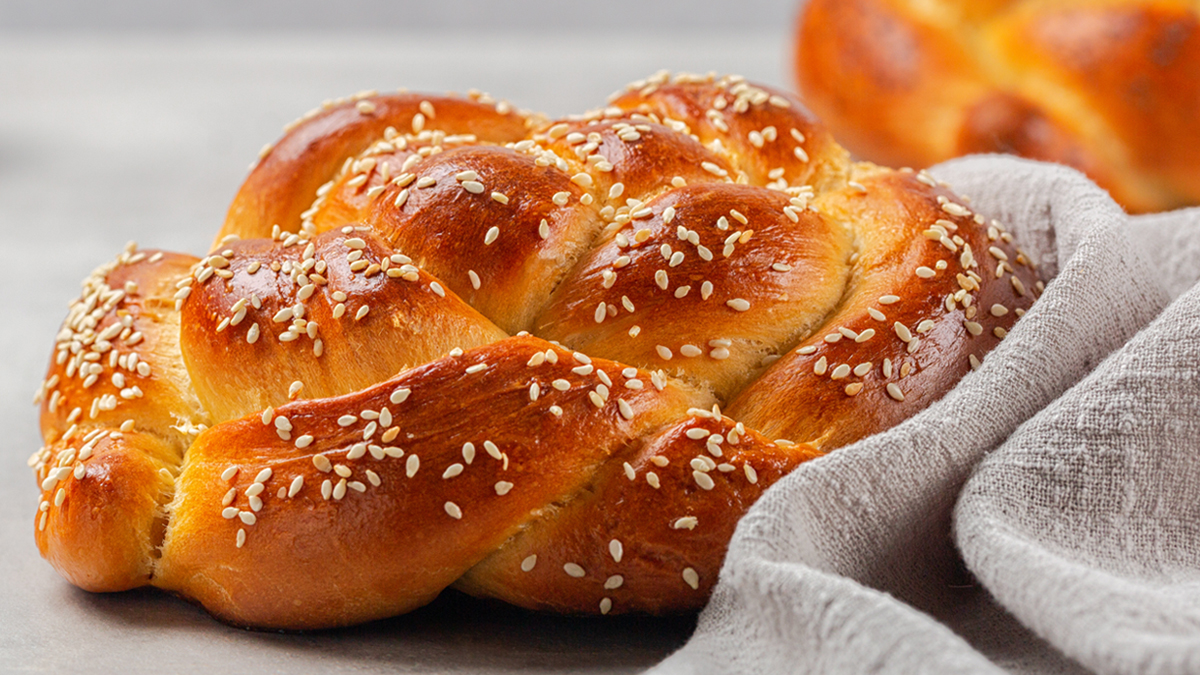
Let’s be honest. Baking challah looks impressive. Like… suspiciously impressive. The braids, the golden shine, the whole “I just casually made this” energy.
But it’s not complicated. It’s basically flour, water, yeast… and a bit of patience. No secret baking degree required.
Your first loaf might look slightly wonky. That’s fine. Wonky challah still tastes like challah, which is what really matters.
Let’s do this!
In This Article
The Basic Challah Recipe
Yields: 2 medium loaves
Ingredients
- 1½ cups warm water
- 1½ tablespoons active dry yeast (about 2 packets)
- ½ cup sugar
- ½ cup neutral oil (canola, vegetable, or safflower)
- 2 large eggs (plus 1 extra for egg wash)
- 1 tablespoon kosher salt
- 7 to 8 cups all-purpose or bread flour

Step-by-step
-
Wake up the yeast
Mix the warm water, yeast, and a small pinch of sugar in a big bowl. Leave it alone for 5–10 minutes. If it gets foamy, congratulations, your yeast is alive and cooperative.
-
Add the good stuff
Whisk in the rest of the sugar, the oil, and the eggs. It won’t look like anything special yet. That’s normal.
-
Bring in the flour
Add the salt and about 4 cups of flour. Stir. Then keep adding flour gradually until it becomes a soft dough that pulls away from the bowl. Not perfect, just… dough.
-
Knead (a little workout moment)
Turn it onto a floured surface and knead for about 10 minutes. Yes, your arms will notice. The dough should end up smooth and a bit springy. Slightly tacky is good. Sticky chaos is not.
-
Let it rise
Place the dough in an oiled bowl, cover it, and let it sit somewhere warm for 1½ to 2 hours. It should double in size. This is your break. You’ve earned it.
-
Shape it
Punch it down gently, no anger issues here. Divide into two. Then braid each loaf with 3 or 6 strands. If your braid looks a bit… abstract, that’s part of the charm.
-
Second rise
Let the shaped loaves rest again for 45–60 minutes. They’ll puff up nicely.
-
Bake
Preheat your oven to 350°F (180°C). Brush with egg wash for that golden finish. Bake for 30–35 minutes until deeply golden and your kitchen smells like you’ve got your life together.
Optional Twists to Try
After your first successful bake, it’s only natural to start thinking, “what if I just add… something?” That curiosity is part of the fun. Challah lends itself beautifully to small variations, whether you’re in the mood for something savory, sweet, or just a little different.
Everything challah
Egg wash + everything bagel seasoning = instant upgrade.
Citrus twist
Add lemon or orange zest. Suddenly your challah feels very spring-ready.
Za’atar version
Swap the oil for olive oil and sprinkle za’atar on top. Slightly more grown-up, still very easy.
Sweet crumb topping
Mix flour, sugar, and oil into a crumble and sprinkle it on. Now you’ve accidentally made bakery-style challah.
Garlic confit
Put roasted garlic cloves in the pan before the dough. They’ll bake into the bottom and make you feel like a genius.

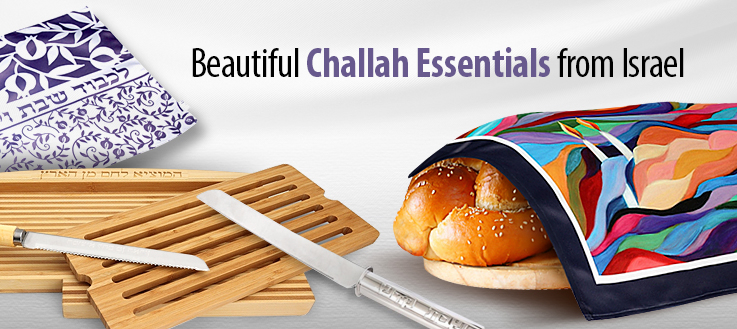
Jordana Klein “Judaism of Joy” Large Glass Challah Tray
Colorful Collector’s Plate Fun Israel Map
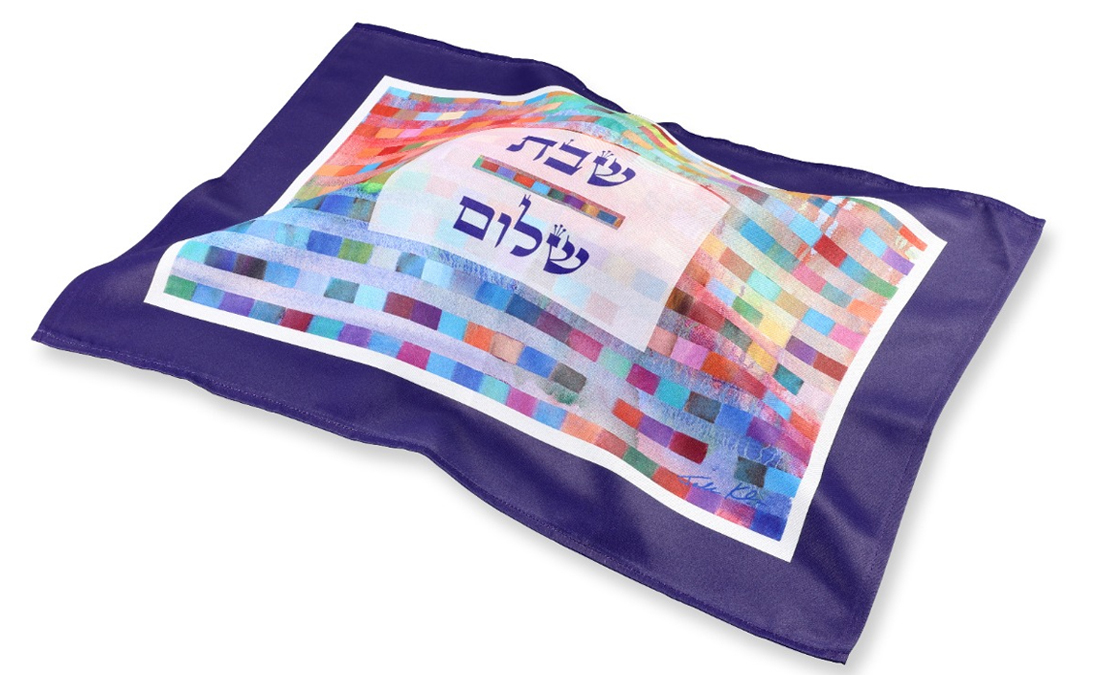
Jordana Klein “Shabbat Rainbow” Challah Cover
The Mitzvah of Taking Challah (Hafrashat Challah)
Taking challah, or hafrashat challah, is a longstanding mitzvah that dates back to the time of the Temple, when a portion of dough was set aside and given to the Kohanim (priests). Today, we continue this practice in a symbolic way when baking larger quantities of dough.
When to perform the mitzvah
In a home kitchen, whether or not you can say the blessing depends on how much flour you are using:
- With a blessing: when using at least 1.66 kg (about 3.6 lbs or 12 cups) of flour
- Without a blessing: between 1.2 kg and 1.66 kg (about 2.6–3.6 lbs)
- No separation needed: if using less than 1.2 kg of flour
The timing
The separation is done after the dough has been fully kneaded, but before it is shaped into loaves.
The separation
Stand by your dough and remove a small piece, roughly the size of an olive or a small egg.
The blessing
If you are using enough flour to say the blessing, hold the piece of dough in your right hand and recite:
Baruch Atah Adonai, Eloheinu Melech Ha’olam, asher kidshanu b’mitzvotav v’tzivanu l’hafrish challah.
Translation: Blessed are You, L-rd our G-d, King of the Universe, who has sanctified us with His commandments and commanded us to separate challah.
The declaration
After the blessing, say: “Harei zu challah” (This is challah).
What to do with the separated piece
Since the dough can no longer be given to the Kohanim, it is not eaten. The common custom is to wrap it in foil and place it in the oven to burn while the loaves bake, or to double-wrap it and dispose of it respectfully.
A special moment
There is a long-standing tradition of using this moment for personal prayer (tefillah), as it is considered a particularly opportune time to ask for health, livelihood, and family.
For more information about our research process, sourcing, and editorial review, please see our editorial standards and content policy.