

1 Samuel 17
For forty days, the armies of Israel and the Philistines stood still, facing each other without engaging in battle. On the fortieth day, David arrived at Saul’s camp. He recognized that Goliath’s weapon was intimidation and understood that the giant had almost defeated Saul’s army through psychological warfare.
The battle in which David killed Goliath, the Philistine giant, is known by millions of people around the world.
The battle is known primarily for its religious message, which says that complete faith in God, not physical strength, is the key to victory! The religious message is, of course, true. Yet alongside it, there is a surprising and fascinating historical and psychological twist that is hardly known.
In the days of the reign of Saul, the first king of Israel, a group of peoples called the Philistines were the bitter enemies of Israel. Indeed, the Book of Samuel tells of the many wars that broke out between the two nations.
During the battle in which David killed Goliath, Saul and his warriors were positioned on one side. Not far from them, the Philistines were positioned. For forty days the two rival armies stood still, facing each other, and no battle broke out. Throughout all those days, twice a day, a giant named Goliath came out from the Philistine camp to curse the God of Israel and King Saul.
Scholars who calculated Goliath’s height according to the data written in the Book of Samuel, claim that he rose to a height of 6.6 feet! Goliath wore armor made of bronze, and on his head, he wore a bronze helmet. On his shoulders he carried a javelin and an iron spear. The scholars who calculated the weight of the armor and weapons he carried concluded that the equipment weighed about 180 pounds. In simple words: Goliath was a very strong giant! When he wore his battle garments, he looked like a tower, like a walking fortress that no one could bring down.
And that’s not all.
As the Bible says, twice a day, in the early morning and at sunset, Goliath approached the camp of Israel. In a thundering voice that sounded like the roar of a lion, he cursed the God of Israel and King Saul. The audacious Goliath, who provoked Saul, shouted to him to send one warrior to fight him. The warrior who wins would determine the outcome of the entire war. Of course, none of Saul’s warriors volunteered for this suicide mission.
Goliath’s repeated provocations struck terror into Saul’s warriors. When they saw him approaching, they fled from him in panic. This routine continued twice a day for forty consecutive days.
David Arrives
On the fortieth day, a young shepherd named David arrived at the camp. When David heard Goliath’s curses and boastful words, he decided to kill him by himself. However, Saul was convinced that Goliath would kill David with one punch and refused to allow him to go out to fight the Philistine. But David was stubborn, and eventually the king gave in to him.

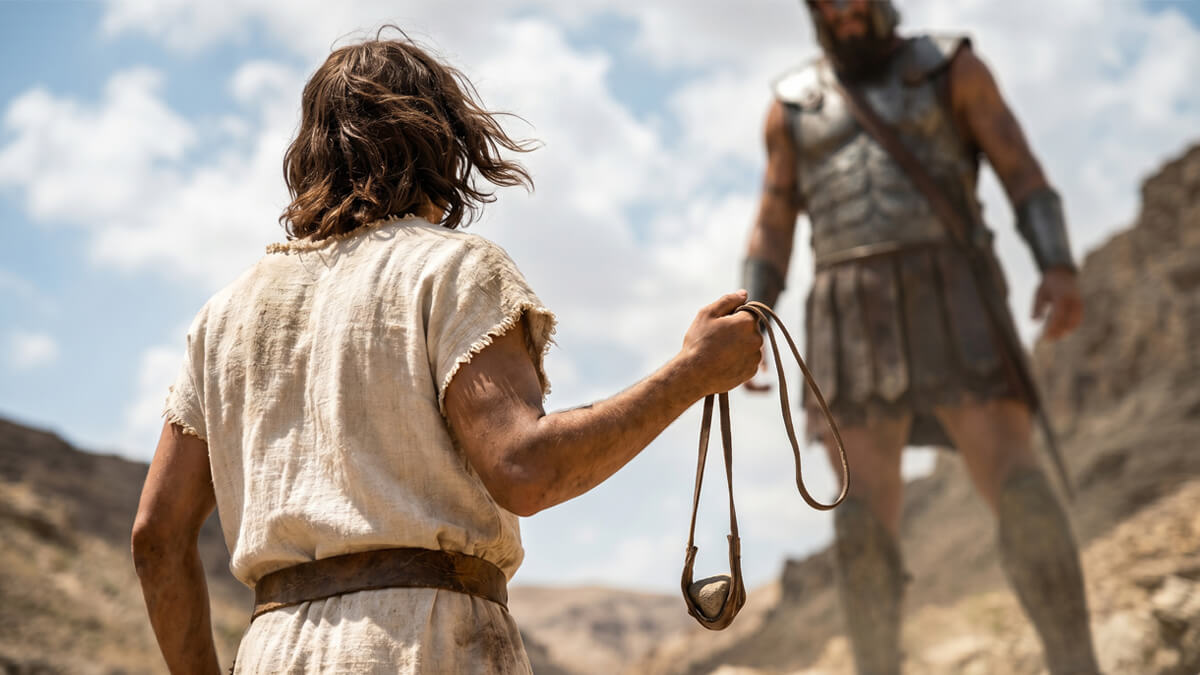
The weapon David used was a sling. David placed a stone in the center of the sling and ran toward the giant. When he reached a suitable distance, he quickly swung the sling above his head. At the precise angle, he released the stone, which struck Goliath’s forehead. The stone penetrated his brain and killed him.
The Turning Point
Up to this point, this story is known to millions of people. Now I will add to it the historical and psychological dimension. When David arrived at Saul’s camp, he immediately realized that, as a warrior, Goliath was a pitiful man and completely worthless. The Philistine giant indeed looked like a fortress, but he was heavy and cumbersome and barely moved. Even a very strong man would have difficulty walking and fighting while carrying battle garments and weapons weighing 180 pounds. Furthermore, anyone wearing bronze armor in the hot weather of the Land of Israel, where the battle took place, would understand that Goliath’s battle armor was like a furnace. In order not to roast inside the cage he wore, Goliath went out to curse the children of Israel at first light and at sunset.

Sharp-eyed David immediately noticed the Philistine’s weak point: the helmet he wore on his head did not protect his forehead – and the forehead of a man so tall could only be struck from a distance, not in hand-to-hand combat! Therefore, from the beginning, David did not intend to approach Goliath.
The weapon David used was a sling, and we have to explain what a sling is. It is a weapon used by shepherds to drive away a wolf or jackal that preys on a goat or sheep. A sling is a long leather strap in which the shepherd places a stone. The shepherd swings the leather strap quickly above his head, and at the precise angle he releases one end of the strap. The stone that is trapped in it flies at tremendous speed to a distance of 66 feet. A skilled shepherd who knew how to use a sling could kill a wolf from a distance of 66 feet. From such a distance he could strike the forehead of a man who rose to a height of more than 6.6 feet, and David was an excellent marksman.
Goliath’s psychological warfare
Nevertheless, we should not underestimate the Philistine giant. Goliath was a very shrewd man who made excellent use of what is known today as ‘Psychological Warfare’. The armor he wore and the weapons he carried made him much, much larger than he really was. In practice, the battle garments were a costume worn by an actor who specialized in intimidation performances. Together with his thundering voice, Goliath achieved excellent results.
For 40 days, twice a day, his menacing appearance and thundering voice succeeded in instilling fear and a spirit of defeat in Saul’s camp and in causing the warriors to flee in panic. Goliath, who boasted of his strength, repeatedly proposed to Saul that he would send him one warrior, and that the warrior who would win, would determine the fate of the war – and he got exactly what he asked for!
Yet, had David not arrived, Goliath would have won a war in which not even one sword was drawn! David defeated the idolatrous Philistine thanks to his faith in God, but also thanks to the fact that one glance was enough for him to identify Goliath’s weak points.

Dr. Liora Ravid, Ph.D. in Biblical Studies, is a leading authority on the history, language, and society of the biblical world.
In DAILY LIFE IN BIBLICAL TIMES, Ravid takes readers thousands of years back, revealing the social and legal realities that shaped biblical society. The book is written in clear and accessible language and provides explanations of biblical wordplays that cannot be translated literally.
Follow Dr. Liora Ravid on YouTube: YouTube Channel | YouTube Shorts
For more information about our research process, sourcing, and editorial review, please see our editorial standards and content policy.