


Tel Aviv wasn’t always the city that never sleeps, in fact, there once was a time when Tel Aviv was just a quiet costal town. In 1909, a group of Jews gathered together on the beach just north of Jaffa and decided that this would be where they would live. They divided up the sandy plot of land and drew lots to determine each family’s home. Soon enough, houses and schools were built, and Tel Aviv became the first modern and completely Jewish city. While it came from humble beginnings, Tel Aviv quickly became a bustling city, constantly keeping up with the times. In the 1930s, Jews from Germany fled to Israel as the Nazis came to power and settled in Tel Aviv, bringing with them a skill that would result in Tel Aviv’s White City.
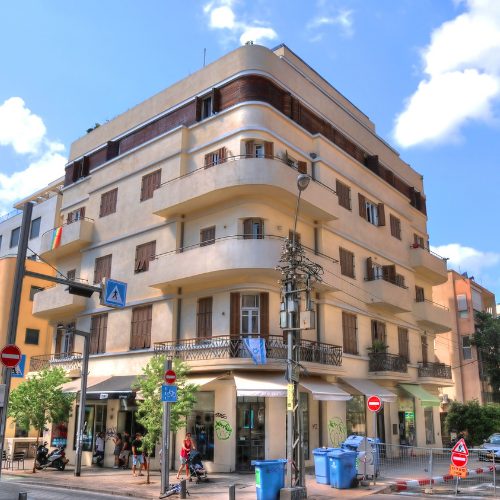
Tel Aviv’s White City is comprised of thousands of Bauhaus style buildings, the modern architecture of the time in Germany. Many of the Jews that came during the 1920s and 30s were architects who studied at the Bauhaus School. While Tel Aviv was still a relatively new city, with room to grow as sand surrounded them, the mayor, Meir Dizengoff, allowed for these buildings to be built as long as they fit in with Patrick Geddes’ master plan. Geddes was a Scottish urban planner who mapped out the future city of Tel Aviv, but did not have a plan for the building styles. Bauhaus-esque buildings were functional and inexpensive, making them the perfect building for a new and growing city.
Bauhaus buildings came up all over the city, but not in the traditional style. The Jewish German architects made small changes to the buildings so that it would work with the Mediterranean weather. Buildings were painted white, cream or gray to reflect the heat, windows were made smaller than the ones in Europe to keep the insides cool, and the roofs were made flat so that residents could sit on the rooftops at night and enjoy the ocean breeze.
The Bauhaus buildings can be found all over the city, sometimes many found in small areas, while others stand alone on city blocks, but they have been inhabited since the 1930s. This piece of modern history has made such an impact that even UNESCO has declared the White City as a World Cultural Heritage Site in 2003. The different styles can be seen by simply walking through the streets or by a tour through the Bauhaus Center.