

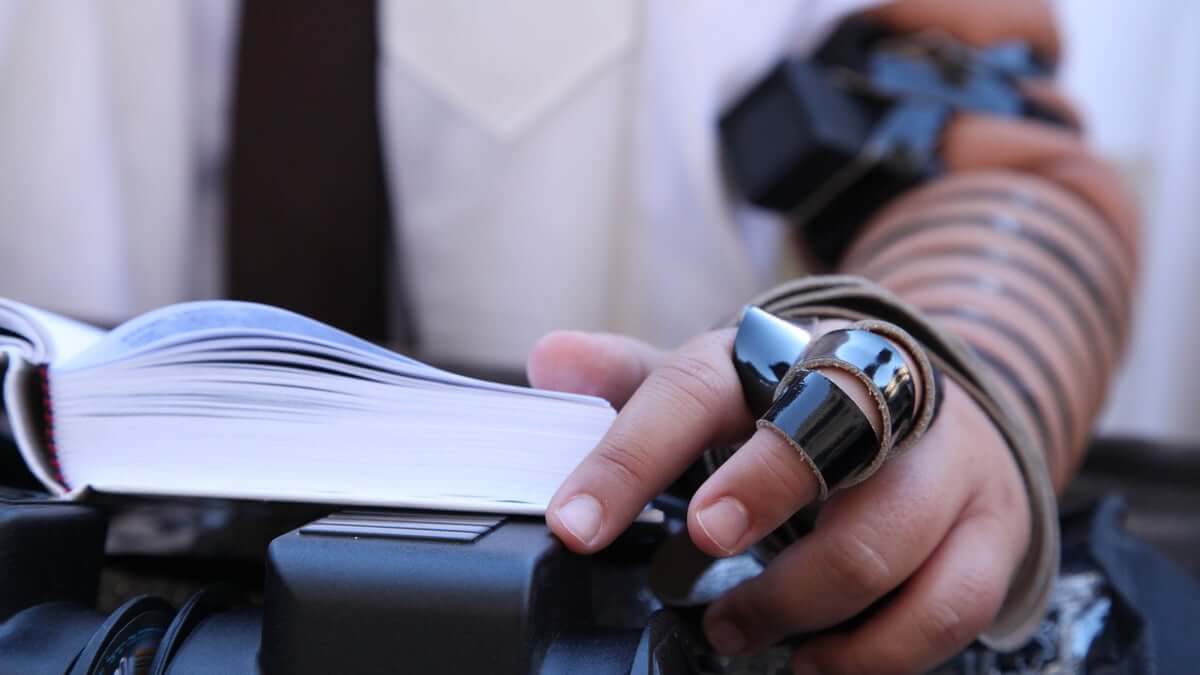
There is something deeply profound in tying the leather strap around oneself because the simple act of doing so connects one’s arm, heart, and mind to something infinite.
The Tefillin is made up of two small black leather boxes, each containing Torah scrolls that have been written by hand. They are worn on the arm and head during morning prayers on weekdays by Jewish men. The practice fulfills a biblical commandment (mitzvah) mentioned four times in the Torah and serves as a physical act of connecting human intellect, emotion, and action to God.
Whether you are getting ready for a Bar Mitzvah, discovering mitzvah for the first time, or trying to learn more about Jewish prayer tefillin, this resource will help you discover all the answers in one article. You will uncover the true meaning of tefillin, explore the different types, understand the laws of kashrut, and learn how to properly wrap them and choose the right pair.
To truly understand tefillin and its role in daily Jewish life, we have to look back at its origins and the deep symbolism woven into its physical form.
Table of Content
1. What Are Tefillin? (Origin & Meaning)
2. The Anatomy of Tefillin
3. Types of Tefillin
4. Who Wears Tefillin & When?
5. How to Put On Tefillin (Hanachas Tefillin)
6. Tefillin Kashrut: What Makes Tefillin Kosher?
7. How Much Do Tefillin Cost?
8. How to Buy Tefillin Online
9. Caring for Your Tefillin
10. Frequently Asked Questions
11. Sources
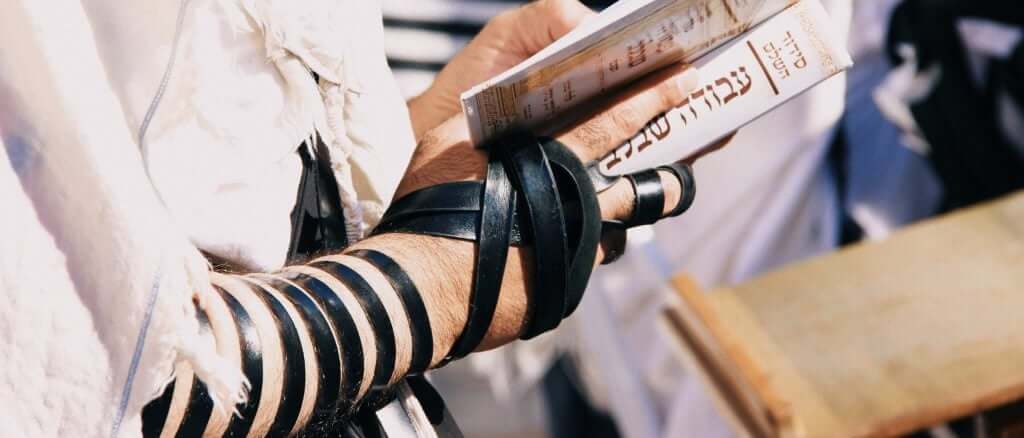
1. What Are Tefillin? (Origin & Meaning)
Origin
It is mentioned four times in the Torah: Exodus 13:9, Exodus 13:16, Deuteronomy 6:8, and Deuteronomy 11:18. According to Deuteronomy 6:8: “You shall bind them as a sign upon your hand, and they shall be for a reminder between your eyes.” Significantly, the name Tefillin is nowhere to be found in the Torah text; rather, the biblical Hebrew term is totafot, which can be loosely translated as headband or frontlets. The term tefillin derives from Mishnaic Hebrew (the language of the Talmud) and stems from the root tefillah, denoting prayer and devotion. It was through rabbinic commentary on these four verses that the specific designations became standardized.
Nonetheless, the practice itself has a very long history. Indeed, the oldest set of tefillin yet discovered came in the form of ancient parchment fragments with these four biblical verses inscribed within them, excavated from among the Dead Sea Scrolls in Qumran, placing their physical origin well beyond 2000 years ago.
Symbolism
More than just an ancient ritual, the tefillin Jewish symbol is one of total devotion. The arm box (shel yad) is placed on the inner bicep, angled inward to face the heart. This placement represents the dedication of our emotions, our desires, and our physical actions to God.
The head box (shel rosh) is placed resting just above the forehead, above the hairline, near the brain. This represents the dedication of our intellect, our thoughts, and our attention.
When worn together, they represent the complete dedication of the whole person. As the great Jewish philosopher Maimonides (the Rambam) wrote, the act of wearing Tefillin helps a person remain God-fearing, keeping their mind focused on truth and righteousness throughout the busy day.
The external components form a divine seal: the letter shin on the head box, the dalet formed by the knot at the base of the neck, and the yud formed by the knot on the arm together spell Shaddai, one of God’s holy names. It is a daily reminder that the physical world and the sacred are beautifully inseparable within tefillin Jewish traditions.
Understanding the mitzvah of tefillin requires looking at the remarkable craftsmanship required to build them. Every part of this sacred object is governed by precise halachic (legal) requirements.
2. The Anatomy of Tefillin
The Physical Components
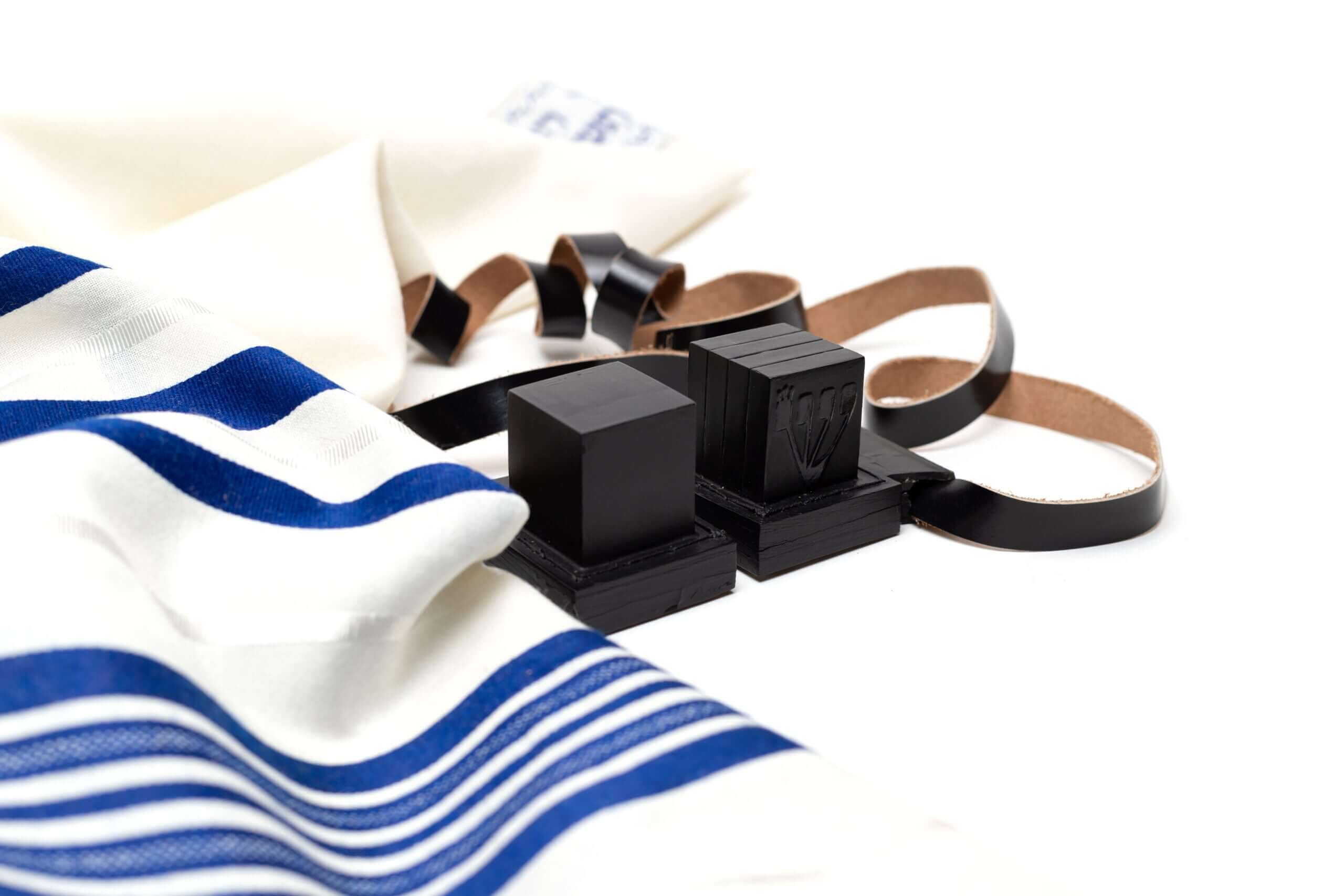
The exterior of Tefillin consists of a few distinct parts:
- Bayit: The square box itself (plural: batim).
- Titurah: The wider, flat base that the box sits upon.
- Ma’abarta: The hollow tunnel or passageway at the back of the base where the straps are threaded through.
- Retzuah: The leather strap used for binding (plural: retzuot).
Every single material used to create these components must come from a kosher animal. This includes the leather for the boxes, the parchment inside, the sinew thread used to stitch the base closed, and even the animal hair used to tie the scrolls inside.
What’s Inside Tefillin?
Inside every tefillin box are the handwritten tefillin parchment scrolls, known as parshiot. These are meticulously written by a specialized scribe and contain the four Torah passages mentioned earlier:
- Exodus 13:1-10: Commands the Jewish people to remember the Exodus from Egypt.
- Exodus 13:11-16: Reaffirms the duty to transmit the story of the Exodus to future generations.
- Deuteronomy 6:4-9: The famous Shema prayer, declaring the oneness of God.
- Deuteronomy 11:13-21: Details the rewards for fulfilling God’s commandments and the consequences of abandoning them.
There is a key difference in how these scrolls are housed. The arm Tefillin contains just one compartment, housing a single tefillin scroll with all four passages written on it. The head Tefillin is divided internally into four separate compartments, each holding a tiny, individually rolled scroll for each of the four passages.
When you shop for Tefillin, you will notice various options. Tefillin can be categorized in two distinct ways: by tradition (which community customs you follow) and by quality (the grade of the parchment and craftsmanship). These two categories are entirely independent. For example, if you follow Ashkenazic customs, you can choose basic or premium quality, and the same applies to Sephardic traditions.
3. Types of Tefillin
By Tradition: Ashkenazic, Sephardic & Yemenite
- Rashi Tefillin: This is the standard tradition for Ashkenazic Jews, named after Rashi, one of the most influential Torah commentators in Jewish history. This is the most common type of Tefillin worldwide.
- Sephardic Tefillin: Followed by Jews of Middle Eastern, North African, and Spanish descent. While the structure is similar, there are slight differences in the exact calligraphy and form of certain Hebrew letters on the parchment.
- Rabbeinu Tam Tefillin: Named after Rashi’s grandson, this is a second pair worn by some Ashkenazic and Chassidic men, usually put on briefly after the main morning prayers. The order of the Torah passages inside differs from Rashi Tefillin. This is not a beginner’s pair, but rather for those already deeply established in daily practice.
Note: Rabbeinu Tam Tefillin do not replace the Rashi tefillin. They are put on in addition to Rashi set.
- Yemenite Tefillin: A distinct tradition followed by Yemenite Jewish communities, featuring unique differences in the letter forms on the parchment.
- Chabad Tefillin: Following the rulings of the Alter Rebbe (Rabbi Schneur Zalman of Liadi, founder of Chabad), these tefillin are distinguished by usually being much larger batim (boxes) and specific letter forms on the parchment that reflect a unique halachic synthesis.
4. Who Wears Tefillin & When?
Who Is Obligated?
Jewish males from Bar Mitzvah age (13) onward are obligated to wear Tefillin. However, many boys begin practicing the wrapping process one to two months before their actual Bar Mitzvah to become comfortable with the blessings and physical motions.
Regarding women wearing tefillin: In Orthodox communities, women are exempt from this mitzvah because it falls under the category of “time-bound positive commandments” (mitzvot that must be performed at specific times of the day), from which women are generally exempt. However, some Conservative and Reform communities actively welcome women and tefillin as a meaningful spiritual practice.
When to Wear Tefillin
- Morning Prayers: Tefillin are primarily worn during weekday morning prayers (Shacharit). They can be put on from approximately one hour before sunrise (a time known as misheyakir).
- During the Day: If you miss morning prayers, you may put on Tefillin at any point during the daytime before the sun sets.
- Chabad Custom: Following the ideal that one should ideally wear them all day, Chabad Chassidim often wear them for an extended period throughout the morning.
- Tallis and Tefillin: It is common practice to put on the tallit (prayer shawl) first, and then the Tefillin. For this reason, many families purchase a beautiful tallis and tefillin set together for a Bar Mitzvah.
When NOT to Wear Tefillin
- Shabbat and Yom Tov: Tefillin are strictly not worn on Shabbat or major Jewish holidays (such as Passover, Shavuot, or Rosh Hashanah). The Torah refers to Shabbat itself as a “sign” between God and the Jewish people; therefore, the physical “sign” of Tefillin is unnecessary on those holy days.
- At Night: They may not be worn from nightfall (the appearance of three stars) until sunrise the following morning.
Special Cases
- Tisha B’Av: According to most Ashkenazic customs, tefillin tisha b’av practices differ from normal days; they are not worn during the morning service (Shacharit), but rather put on later in the afternoon for Mincha. Sephardic custom, however, dictates wearing them normally in the morning.
- Purim: You might wonder about purim tefillin. Because Purim is a rabbinic holiday and not a major Torah festival, Tefillin are worn normally during morning prayers.
- Chol HaMoed: During the intermediate days of Passover and Sukkot, customs vary widely. Ashkenazim have differing practices depending on their specific community, while Sephardic Jews and Chabad Chassidim do not wear them. Always consult your rabbi regarding Chol HaMoed.
Learning proper tefillin wrapping (known in Hebrew as hanachas tefillin) takes a little practice, but it quickly becomes a deeply meditative morning routine. Here is a step-by-step guide to putting tefillin on properly.
5. How to Put On Tefillin (Hanachas Tefillin)
Before You Begin
- If you wear a tallit, put it on first. (Note: wearing a tallit is not a prerequisite for wearing tefillin).
- Stand facing east, toward Jerusalem, if possible. At a minimum, stand while reciting the blessing over the arm Tefillin.
- Have a siddur (prayer book) or a prayer card nearby.
Note: Ashkenazic Jews recite two blessings, one for the arm and one for the head. Sephardic Jews and many Chassidim recite only one blessing over the arm box. Follow your community’s custom. Do not speak or interrupt yourself between putting on the arm and head boxes.
1. Putting On the Arm Tefillin (Shel Yad)
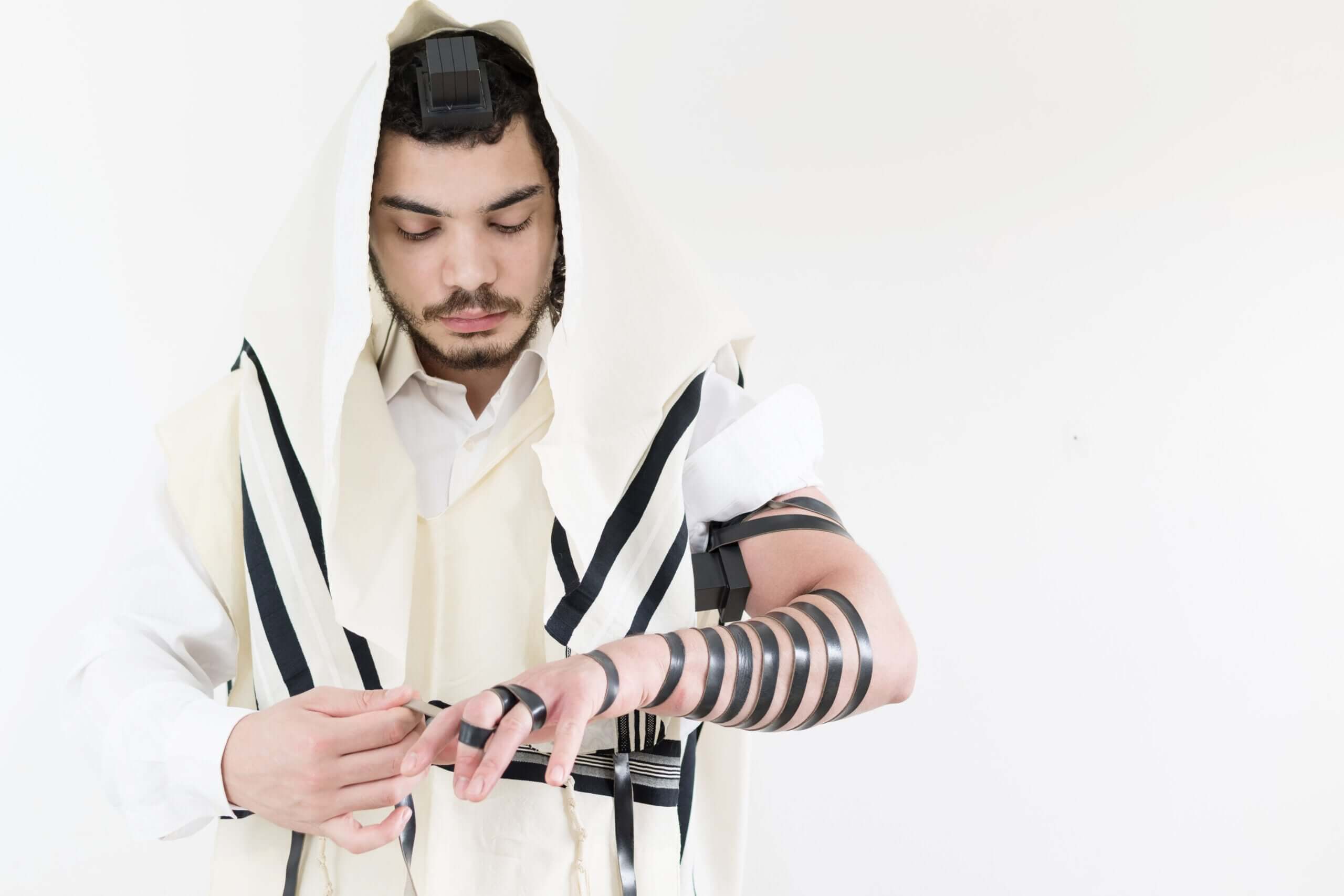
Remove only the arm Tefillin from the bag first, to avoid passing over the head Tefillin out of respect. Place the box on the inner side of your upper arm (the bicep), facing toward your heart.
Note on left handed tefillin: Left-handed individuals wear the arm Tefillin on their right arm (the non-dominant arm). Right-handed individuals wear it on their left arm.
Tighten the jewish leather straps at the bicep. Make sure the knot on the arm strap remains touching the box at all times, this is a halachic requirement.
Recite the blessing in Hebrew:
- Transliteration: Baruch Atah Adonai, Eloheinu Melech ha’olam, asher kid’shanu b’mitzvotav v’tzivanu l’haniach tefillin.
- Tefillin prayer English translation: “Blessed are You, Hashem our God, King of the universe, who has sanctified us with His commandments and commanded us to lay Tefillin.”
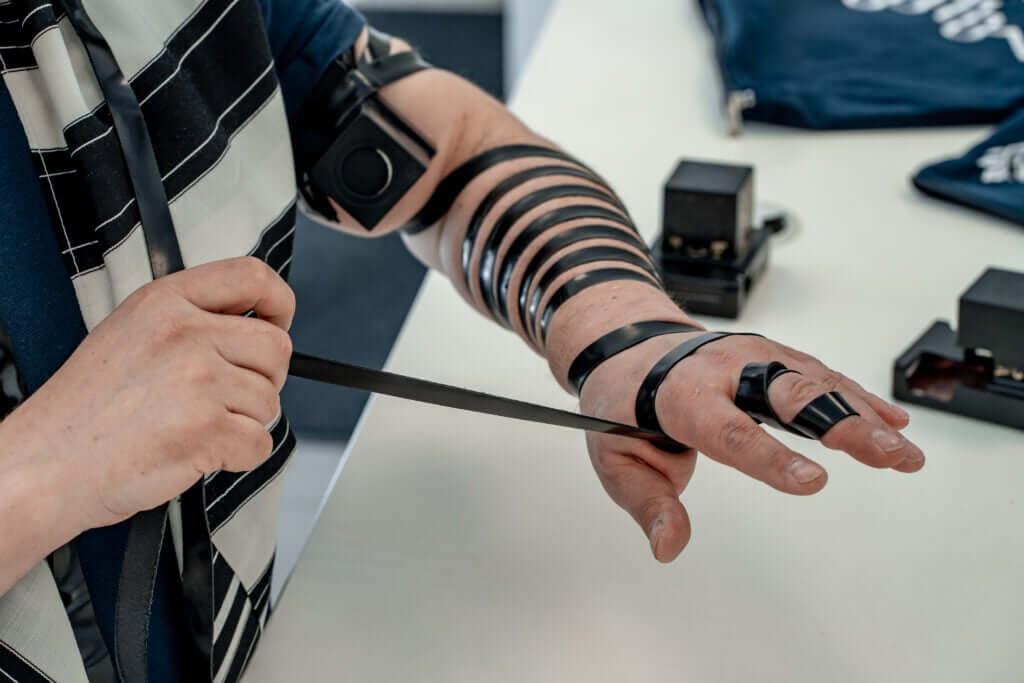
Wrap the strap seven times around your forearm, winding downward toward the hand, and then wrap it loosely around your palm for now. (The exact direction of these jewish wraps varies slightly by community tradition).
2. Putting On the Head Tefillin (Shel Rosh)
Take out the head Tefillin and place it resting above your hairline, at the point where hair begins to grow, not down on your forehead. Also make sure that it rest in the center between the eyes. Many tefillin boxes come with a mirror, or have one built in specifically for this step. Of course many people also use their phones cameras as well. Tighten the strap so that the dalet knot rests securely at the base of your skull. Let the two long straps fall in front over your shoulders.
Recite the second blessing (Ashkenazic custom):
- Transliteration: Baruch Atah Adonai, Eloheinu Melech ha’olam, asher kid’shanu b’mitzvotav v’tzivanu al mitzvat tefillin.
- Translation: “Blessed are You, Hashem our God, King of the universe, who has sanctified us with His commandments and commanded us concerning the mitzvah of Tefillin.”
(Some add quietly: “Baruch shem kavod malkhuto l’olam va’ed” – “Blessed is the name of His glorious kingdom forever and ever.”)
3. Completing the Hand Wrapping
Unwrap the strap from your palm and complete the final winding around your hand, including wrapping it three times around your middle finger. The exact pattern of which joints you cross and in what order varies by custom, but together, these windings form the Hebrew letters dalet and yud on your hand. Combined with the shin on the head box, you have physically bound the name Shaddai to yourself.
Removing Tefillin
When your prayers are complete, remove the items in reverse order. Unwrap your hand first, then remove the head Tefillin, and finally the arm Tefillin. (Some Sephardic and Chassidic communities remove the arm Tefillin first, consult your rabbi). Wind the tefillin straps neatly and respectfully before returning them to their bag.
When exploring kosher tefillin, you are looking for more than just a beautiful exterior; the spiritual validity of the mitzvah relies entirely on what goes into the creation of the set. All Tefillin should be certified kosher in strict accordance with halacha (Jewish law). Their kashrut depends heavily on the precise, expert work of a qualified sofer STaM (scribe), who writes the tefillin parchment scrolls entirely by hand under exacting halachic requirements.
Quality kosher tefillin are produced with carefully prepared materials and are meticulously checked to ensure they meet the highest possible standards of kashrut. Because the average person cannot verify the internal scrolls themselves, Tefillin should always be obtained from a trusted source that provides reliable kashrut certification from a recognized rabbinical authority.
Ongoing Care & Inspection
Tefillin should be periodically checked by a qualified sofer to ensure they remain kosher over time, as natural wear, temperature changes, and perspiration can affect the parchment, lettering, and structural integrity of the tefillin box. A thorough check (known as a bedikah) is typically recommended twice every 7 years with regular use, and sooner if the Tefillin have been exposed to moisture, impact, or damage.
If you have old tefillin that are damaged beyond repair or have become invalid, they contain God’s name and cannot simply be thrown away. They must be buried respectfully in a Jewish cemetery in a process known as genizah. Your local rabbi or synagogue can easily provide guidance on how to arrange this.
6. Tefillin Kashrut: What Makes Tefillin Kosher?
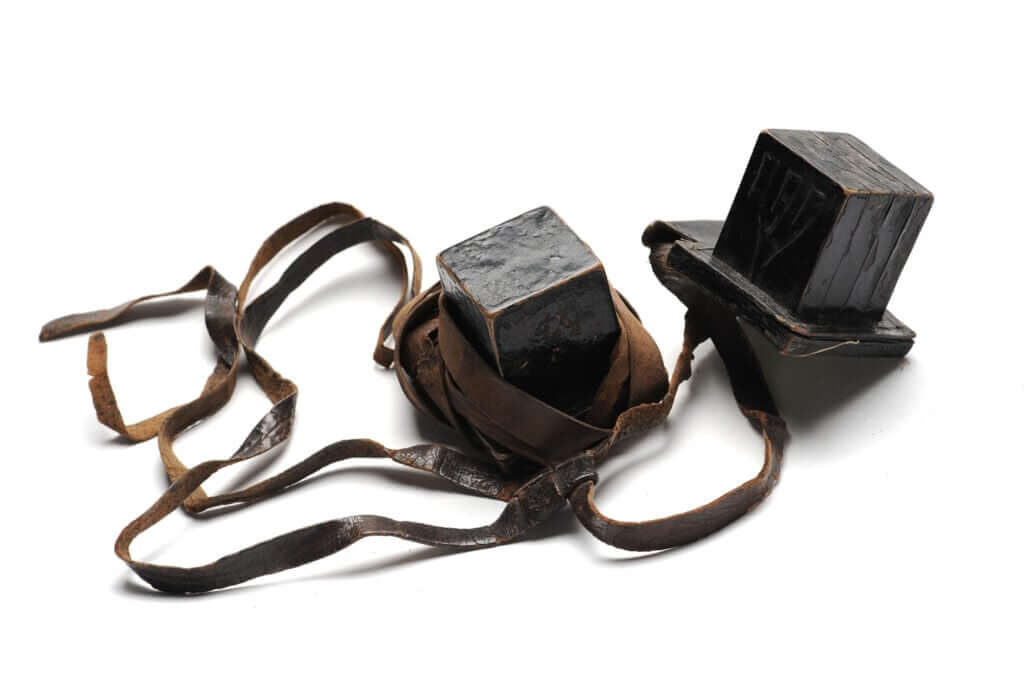
What Makes Tefillin Kosher? – A Quick Checklist
- Parshiot (scrolls): Must be completely handwritten by a certified, God-fearing Jewish scribe (sofer).
- Parchment (klaf): Must be derived from the skin of a kosher animal.
- Ink: Special kosher ink, prepared strictly according to ancient halachic requirements.
- Boxes (batim): Must be perfectly square in shape.
- Coloring: The boxes must be black; the straps must be black on the outer side (some have a custom to blacken both sides).
- Letter Integrity: Every single letter on the tefillin scroll must be complete even a hairline crack, a slight smudge, or missing ink can invalidate the entire set.
- No Printing: Printed or photocopied parchments are NEVER kosher.
Purchasing Tefillin is a once-in-a-generation investment. When evaluating the tefillin price, it helps to remember that the cost reflects an extraordinary amount of skilled human labor. A single sofer can spend between 10 to 30 hours handwriting the parshiot for just one pair, and every single letter must be flawless. This is a sacred, handcrafted object that simply cannot be mass-produced cheaply without cutting dangerous corners on kashrut.
There is a wide range in the cost of tefillin on the market today. You will find entry-level kosher pairs (tefillin peshutim), mid-range standard sets (tefillin dakkot), and premium, lifetime-quality sets (Gassot), all the way up to the most exacting Mehadrin Min HaMehadrin sets that represent the absolute pinnacle of the sofer’s craft. This variance reflects genuine, tangible differences in parchment quality, box craftsmanship, sofer expertise, and long-term durability, not an arbitrary retail markup.
7. How Much Do Tefillin Cost? (Pricing Guide)

What Affects the Price?
- The Sofer’s Experience: A master sofer with a sterling reputation commands a premium for their parshiot, and rightly so.
- Parchment (Klaf) Quality: Producing Dakkot and Gassot parchment requires significantly more preparation, pressing, and expertise than basic materials.
- Box (Batim) Craftsmanship: Creating perfectly square boxes that will not warp or lose their shape over decades of daily use requires immense pressure and skill.
- Strap (Retzuah) Quality: High-quality leather straps that remain black on the correct surfaces without peeling help keep the set kosher longer.
- Inclusions: Some sets come bundled with a tallit, a protective bag, a kippah, or an instructional prayer card.
A Word on Suspiciously Cheap Tefillin If you see tefillin for sale at surprisingly low prices, be incredibly cautious. Bargain prices almost always involve a severe compromise on kashrut, most commonly, printed or photocopied parchments, which are absolutely never kosher. The cost of a qualified sofer’s labor alone makes a truly kosher pair impossible to produce on the cheap. Buying Tefillin is not the time to bargain-hunt.
That standard of uncompromised quality and integrity is what every pair at JudaicaWebStore is built upon, sourced directly from Israel’s finest sofrim. Browse Our Tefillin Collection →
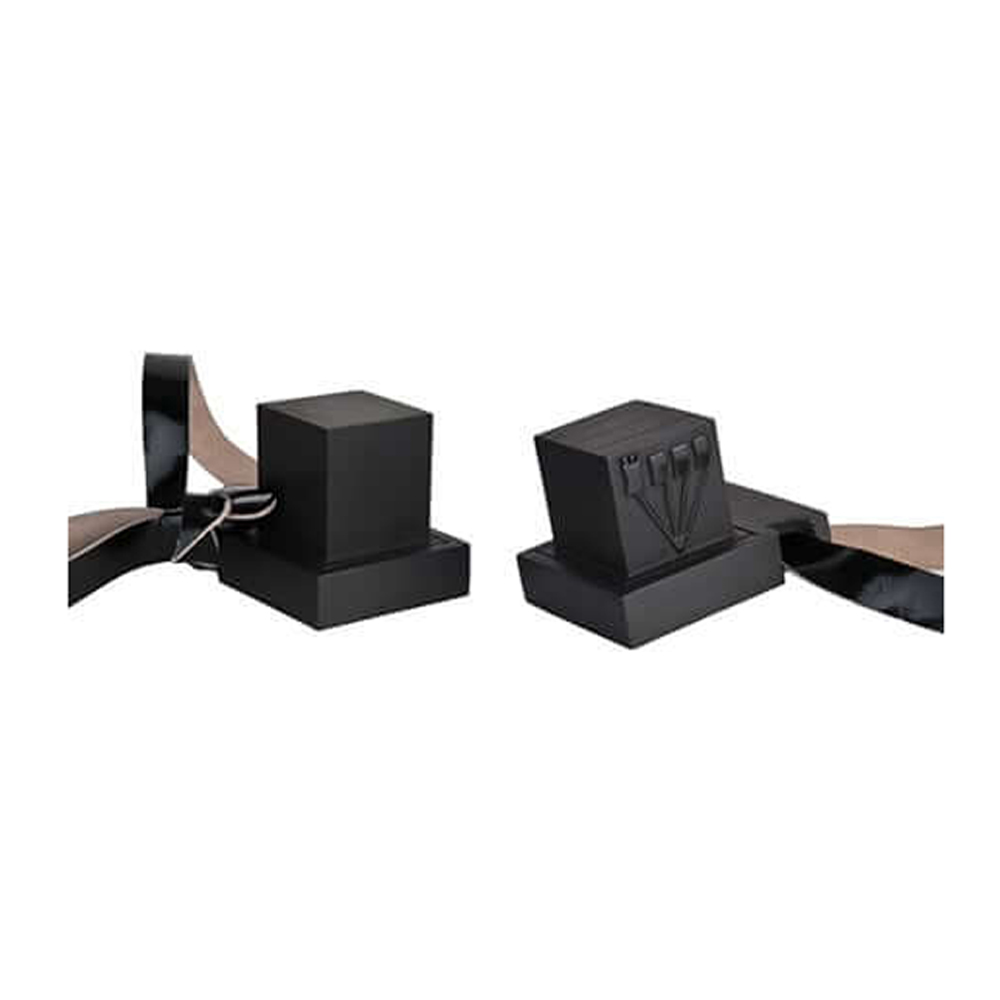
The Finest Tefillin Money Can Buy. Built for a Lifetime.
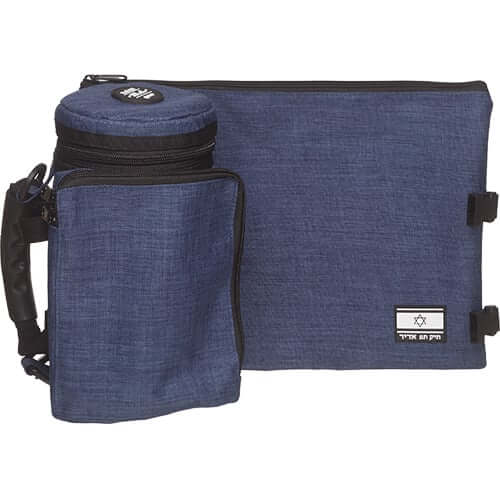
Your Tefillin Deserve Protection. Wherever You Go.
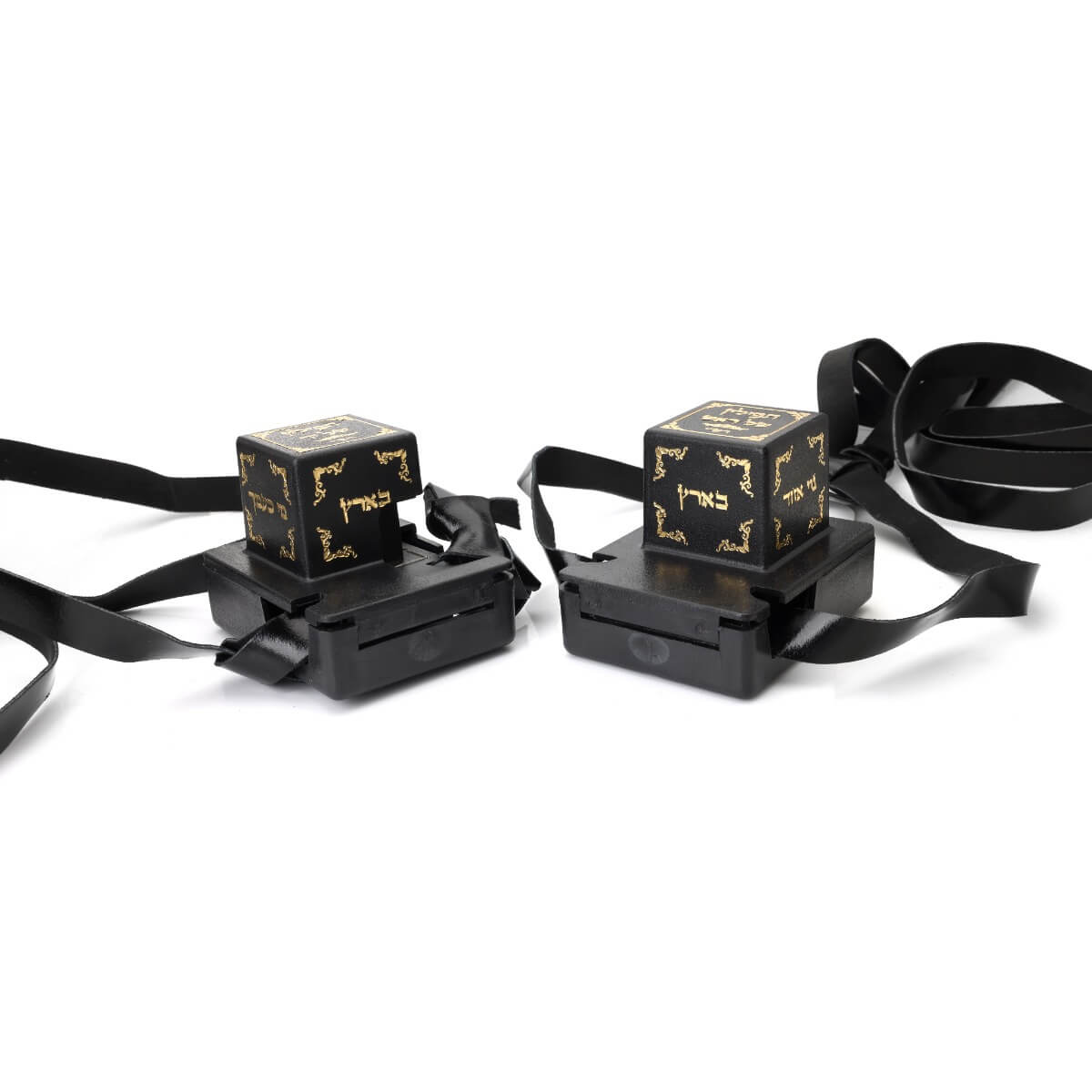
Quality Tefillin at Every Price Point.
8. How to Buy Tefillin Online: What to Look For
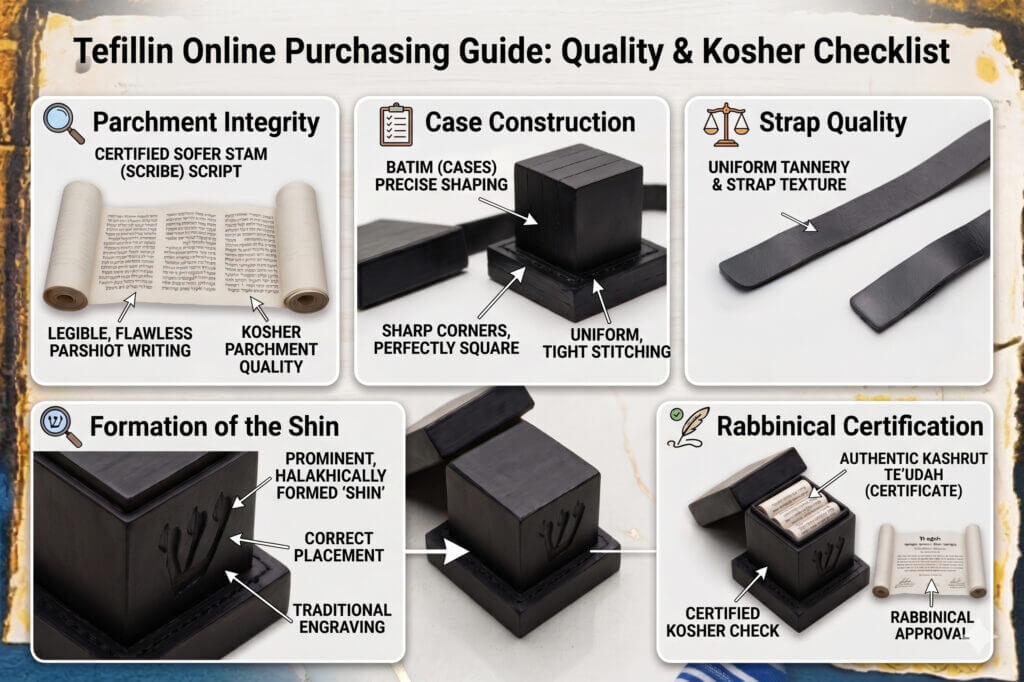
When you buy tefillin online, you are engaging in an act of profound trust. You should feel that the seller naturally upholds the highest standards so you don’t have to nervously interrogate every detail. Any reputable, Israel-based Judaica specialist will readily provide the following as a given:
- Authentic Hand-Written Parshiot: Scrolls written by a certified, God-fearing sofer, this is a must.
- Full Kashrut Certification: Backed by a named certifying rabbinical authority, rather than a vague, generic claim of being “kosher.”
- Clear Quality Levels: Knowing whether you are purchasing Peshutim, Dakkot, or Gassot so you understand exactly what level of durability you are getting.
- Direct Sourcing: Tefillin sourced directly from Israel, the global hub where the world’s finest sofrim and craftsmen are concentrated.
- Responsive Support: A knowledgeable team ready to answer halachic and practical questions.
Whether you are looking for distinct Sephardic tefillin, a pair of small tefillin specifically built for frequent travel, or left handed tefillin (which are the exact same as right-handed pairs, simply worn on the right arm), a reputable supplier will be able to accommodate your needs easily.
Bar Mitzvah Tefillin – Special Considerations A Bar Mitzvah boy will ideally wear his tefillin every single weekday for decades. Because of this, bar mitzvah tefillin are a purchase worth making thoughtfully. Investing in a higher quality level (Dakkot or Gassot) now pays off tremendously over a lifetime of use. It is highly recommended to pair the gift with a matching bag to protect the investment. For more on this milestone, read our complete Bar Mitzvah Guide.
When you know the immense skill and halachic devotion that goes into a genuine pair, the choice of where to buy becomes simple. Shop Tefillin at JudaicaWebStore →
9. Caring for Your Tefillin
To ensure your set lasts a lifetime and remains strictly kosher, proper maintenance is key. Treat them with the deep respect a holy object deserves.
- Proper Storage: Always store your Tefillin in their dedicated tefillin bag when not in use. A high-quality velvet or leather tefillin bag keeps the boxes from getting scratched and prevents the straps from tangling.
- Temperature Control: Keep them at room temperature. Avoid exposing them to extreme heat (never leave them in a parked car during the summer), biting cold, or high humidity. Leather cracks and parchment deteriorates rapidly under environmental stress.
- The Tefillin Mirror: A tefillin mirror is a small mirror placed inside the bag or near where you pray. It helps you check that the head Tefillin is perfectly centered above your hairline, a simple, incredibly useful accessory that many beginners overlook.
- Check the Straps: If the outer surface of the black straps fades, cracks, or peels, they need to be re-blackened by a sofer with kosher ink, or replaced entirely. This is a strict halachic requirement, not just an aesthetic issue.
- Routine Inspections: Have your set inspected (bedikah) by a certified sofer every 3-5 years. The cost is typically modest and ensures your daily prayers are valid.
- Traveling with Tefillin: If you are frequently on the go, travel tefillin require extra care. Use a sturdy tefillin case or a hard-shell tefillin travel bag to prevent the boxes from being crushed. Always keep them in your carry-on luggage during air travel, never check them in the cargo hold.
- Old Tefillin: As mentioned, old tefillin that are damaged beyond repair cannot be thrown in the trash. They must be given a proper burial (genizah). Contact your local Jewish community for guidance.
10. Frequently Asked Questions About Tefillin

What are Tefillin?
Tefillin are two small black leather boxes containing handwritten Torah scrolls, worn on the arm and head by Jewish men during weekday morning prayers. They represent a biblical mitzvah and serve as a physical expression of devotion, tangibly connecting a person’s heart, mind, and action to God.
What is the origin of Tefillin?
Tefillin originate from a biblical commandment appearing four times in the Torah (Exodus 13:9, 13:16; Deuteronomy 6:8, 11:18). The practice has been observed continuously since at least the 1st century CE, confirmed by ancient Tefillin found at Qumran among the Dead Sea Scrolls. The detailed practices were later codified in the Oral Torah (Talmud).
What is the symbolism of Tefillin?
The arm Tefillin represents the dedication of the heart, emotions, and actions to God, while the head Tefillin represents the dedication of the intellect and thought. Together, they represent complete dedication of the self. The Hebrew letters shin, dalet, and yud (found on the box, head knot, and arm knot) spell Shaddai, one of God’s names, making wearing them a daily act of binding oneself to the divine.
Who is required to wear Tefillin?
Jewish males from the age of 13 (Bar Mitzvah) are required to wear Tefillin. In traditional Orthodox halacha, women are exempt, as it is a time-bound positive commandment. However, some Conservative and Reform communities permit or encourage women who choose to wear them. Consult your rabbi and community for guidance.
When are Tefillin worn?
Tefillin are worn during weekday morning prayers (Shacharit) only. They are not worn on Shabbat or major Jewish holidays. They can be worn from approximately one hour before sunrise through the daytime, but never at night. On Tisha B’Av, Ashkenazim wear them at Mincha only, while Sephardim wear them normally. They are also worn on Purim. For Chol HaMoed, customs vary, so ask your rabbi.
How are Tefillin put on?
The arm Tefillin is put on first, placed on the inner bicep of the non-dominant arm (left-handed individuals wear it on the right arm), and the strap is wrapped seven times around the forearm. A blessing is recited. Then the head Tefillin is centered above the hairline with the knot at the back of the skull, and a second blessing is recited. Finally, the strap is wrapped around the hand and three times around the middle finger. See the full step-by-step guide above.
Can women wear Tefillin?
In Orthodox tradition, women are exempt from wearing Tefillin, as it is a time-bound positive commandment. However, some Conservative and Reform communities actively welcome women who choose to wear Tefillin as a spiritual practice. There is no single universal answer, it depends entirely on your tradition and community. Speak with your rabbi for personal guidance.
What makes Tefillin kosher?
Kosher Tefillin require handwritten parshiot (scrolls) by a certified sofer (scribe), parchment derived from a kosher animal, perfectly square black leather boxes, and straps that are black on the required surfaces. Every single letter must be complete, even a hairline crack can invalidate the Tefillin. Printed parchments are never kosher. The sofer’s certification is the single most important indicator of authenticity.
How much do Tefillin cost?
Kosher Tefillin vary in price based on craftsmanship and quality tiers. You can find a basic Peshutim pair for an entry-level budget, Dakkot for mid-range standard quality, premium Gassot for long-term daily use, and Mehadrin Min HaMehadrin for the finest available sets. Be cautious of unusually cheap Tefillin, a truly kosher pair requires many hours of expert work and cannot be produced profitably at very low prices.
How do I know if my Tefillin are still kosher?
Have your Tefillin inspected (bedikah) by a certified sofer every 3-5 years, or immediately after they are dropped, exposed to water or extreme heat, or if the straps have faded. A sofer will open the boxes, examine the parchment under magnification to ensure no letters have cracked, and re-stitch them as needed. This is an affordable service and critical to ensuring your Tefillin remain valid.

Whether you are preparing a son for his Bar Mitzvah, returning to the daily practice, or wrapping the straps for the very first time, choosing the right pair of Tefillin is an incredibly meaningful step. At JudaicaWebStore, every set is sourced directly from Israel and backed by our unwavering commitment to authentic, certified Judaica.
Sources
Primary Biblical Texts
- Exodus 13:1–10 – The commandment to remember the Exodus from Egypt
- Exodus 13:11–16 – The duty to transmit the story of the Exodus to future generations
- Deuteronomy 6:4–9 – The Shema prayer, commanding the binding of words as a sign upon the hand and between the eyes
- Deuteronomy 11:13–21 – The rewards for fulfilling God’s commandments and the consequences of abandoning them
Classical Rabbinic & Halachic Sources
- Maimonides, Mishneh Torah, Laws of Tefillin, Mezuzah, and Torah Scrolls 4:25 – The profound spiritual and psychological impact of wearing Tefillin
- Shulchan Aruch, Orach Chaim 25–45 – The foundational laws detailing obligations, timeframes, and physical construction of Tefillin
Historical & Archaeological Sources
- The Leon Levy Dead Sea Scrolls Digital Library (Israel Antiquities Authority) – Archaeological records documenting ancient Tefillin fragments found at Qumran
Contemporary Educational Sources
- Chabad.org – Practical guides on the laws of Tefillin, step-by-step wrapping, and specific community customs
- Orthodox Union (OU.org) – Halachic rulings on Tefillin kashrut and the intricate role of a sofer STaM
- My Jewish Learning – Overviews of Ashkenazic, Sephardic, and Yemenite traditions, as well as evolving practices regarding women and Tefillin
For more information about our research process, sourcing, and editorial review, please see our editorial standards and content policy.