

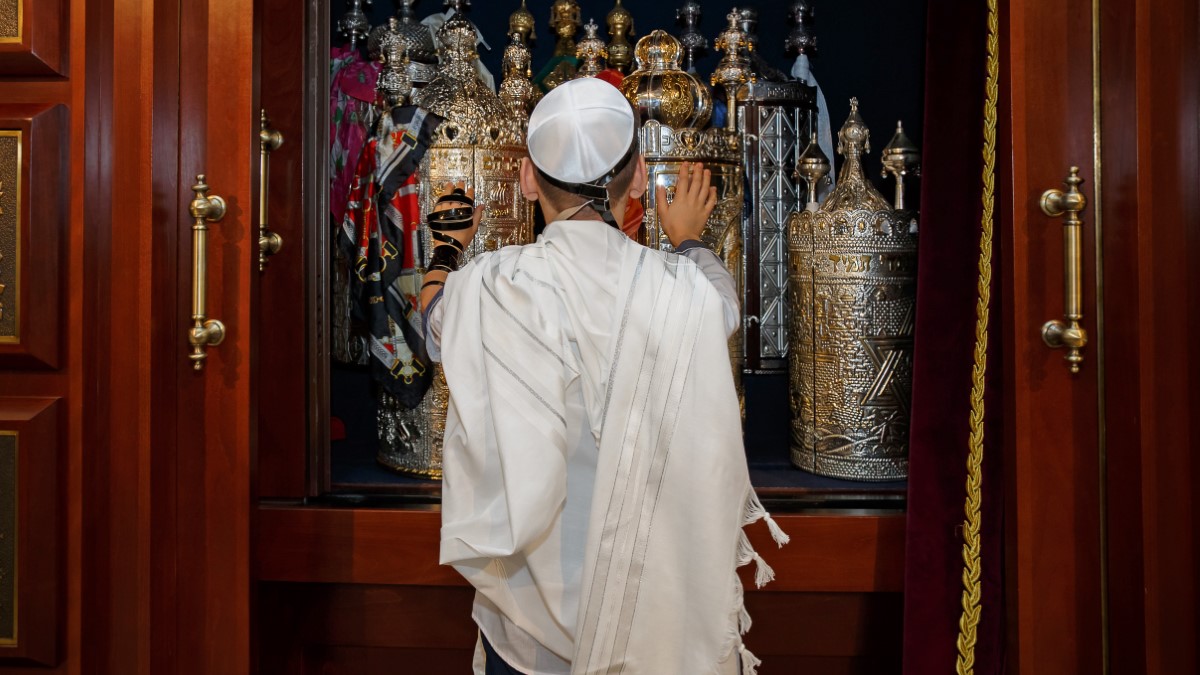
There is a hushed silence in the synagogue just before a 13-year-old boy begins to chant from the Torah for the very first time. As he grasps the wooden handles of the sacred scroll, takes a deep breath, and recites the ancient blessings, he is doing much more than completing a year of rigorous study. He is stepping across a visible, spiritual threshold.
For guests and family members seated in the congregation, the bar mitzvah ceremony is a beautiful, joyous event filled with music, prayers, and celebration. But beneath the surface of the festivities lies a profound spiritual transition. When a Jewish boy reaches his 13th birthday, he undergoes a fundamental shift in his relationship with God, his family, and his community.
What does this ancient ritual actually represent? Why is it celebrated with such immense joy? In this comprehensive guide, we will explore the deep spiritual meaning of the bar mitzvah ceremony, break down the powerful symbolism behind its core rituals, and understand why this milestone remains one of the most vital foundations of Jewish continuity today.
To find out more about giving a gift for a bar mitzvah read our guide, or explore more information on bar mitzvahs in our dedicate blog.
1. Introduction
2. The Spiritual Heart of the Bar Mitzvah Ceremony
3. The Key Elements of the Ceremony and Their Meaning
4. The Symbolism Behind the Joy
5. The Preparation: A Journey of Character
6. What the Ceremony Means for Family and Guests
7. Frequently Asked Questions About Bar Mitzvah Cash Gifts
8. Sources
The Spiritual Heart of the Bar Mitzvah Ceremony
To grasp the true meaning of the bar mitzvah ceremony, we must first translate the title. Bar Mitzvah translates from Aramaic and Hebrew as “Son of the Commandment.” This title is not just a description of the event; it is a description of the young man himself.
Shifting the Weight of Responsibility
In Jewish tradition, children are viewed as pure, developing souls who are not yet fully responsible for their moral or religious choices. Before a boy turns 13, his parents carry the spiritual accountability for his actions. It is the parents’ duty to teach him right from wrong, show him how to observe the mitzvot (commandments), and guide his ethical development.
The bar mitzvah ceremony marks the exact moment that this spiritual weight shifts permanently from the parents’ shoulders to the young man’s own shoulders. He is now legally and morally responsible for his own actions under Jewish law (halacha). He is expected to navigate the complexities of right and wrong, participate actively in the repair of the world (Tikkun Olam), and forge his own personal relationship with the divine.
The Father’s Blessing (Baruch She’ptarani)
One of the most poignant, yet often overlooked, moments of the bar mitzvah ceremony perfectly encapsulates this transition. After the young man completes his first reading from the Torah, his father traditionally recites a very brief, powerful blessing:
“Baruch she-p’tarani me-onsho shel zeh.” (Blessed is He who has freed me from the responsibility of this boy.)
While it sometimes draws a chuckle from the congregation, the meaning is deeply moving. The father is publicly acknowledging that his son is no longer a child reliant on his parents’ spiritual standing. He has become his own man before God.
The Key Elements of the Ceremony and Their Meaning
The traditional bar mitzvah ceremony is centered around the synagogue’s morning prayer service (Shacharit). Every action the young man takes during this service is highly symbolic, designed to publicly demonstrate his new status as a Jewish adult.
The Aliyah: Being Called to the Torah
The undeniable focal point of the bar mitzvah ceremony is the Aliyah. The word aliyah literally means “to go up” or “to ascend.” During the service, the Bar Mitzvah boy is called up to the bimah (the elevated reading platform) to recite the Hebrew blessings before and after a section of the Torah is read.
Why is this so significant? In Jewish law, being called to the Torah for an aliyah is a sacred privilege reserved exclusively for Jewish adults. A child cannot be called to the Torah. Therefore, the very act of the rabbi calling his Hebrew name and inviting him to ascend the bimah is the ultimate public validation that the community now recognizes him as a full-fledged man.
Chanting the Torah and Haftarah
In most ceremonies, the young man does not merely recite the blessings; he takes on the immense responsibility of chanting the Torah portion itself.
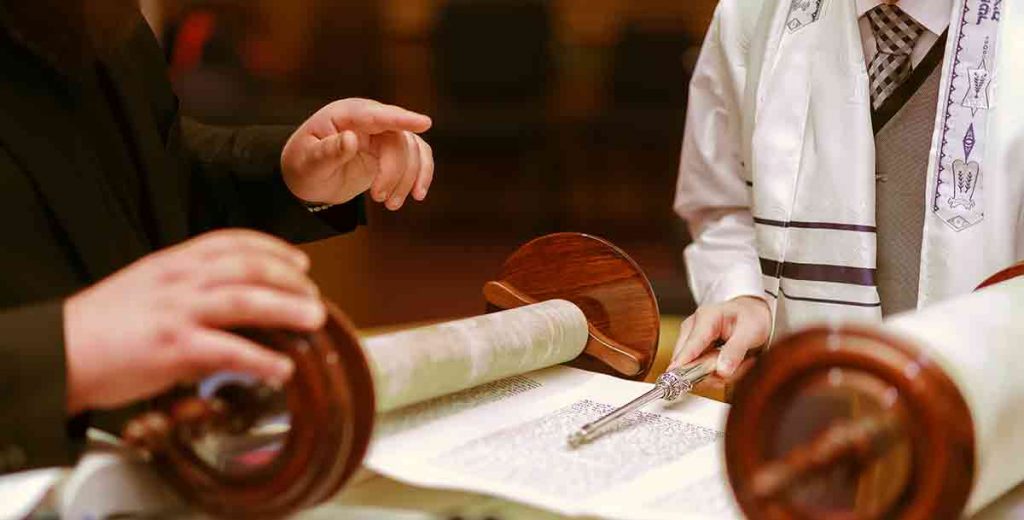
Reading from a kosher Torah scroll is incredibly difficult. The text is handwritten by a scribe without any vowels, punctuation marks, or musical notes. To read it correctly, the boy must spend six to twelve months memorizing the precise pronunciation and the complex musical melodies (known as trop or cantillation). Furthermore, the parchment must never be touched by human hands, so he uses a beautifully crafted silver or wood Torah Pointer (Yad) to keep his place.
Following the Torah reading, he will usually chant the Haftarah, a corresponding reading from the biblical Prophets. By leading the congregation in these readings, he demonstrates that he is not just a passive participant in Jewish life, but an active, capable leader.
Putting on Tefillin: The Physical Covenant
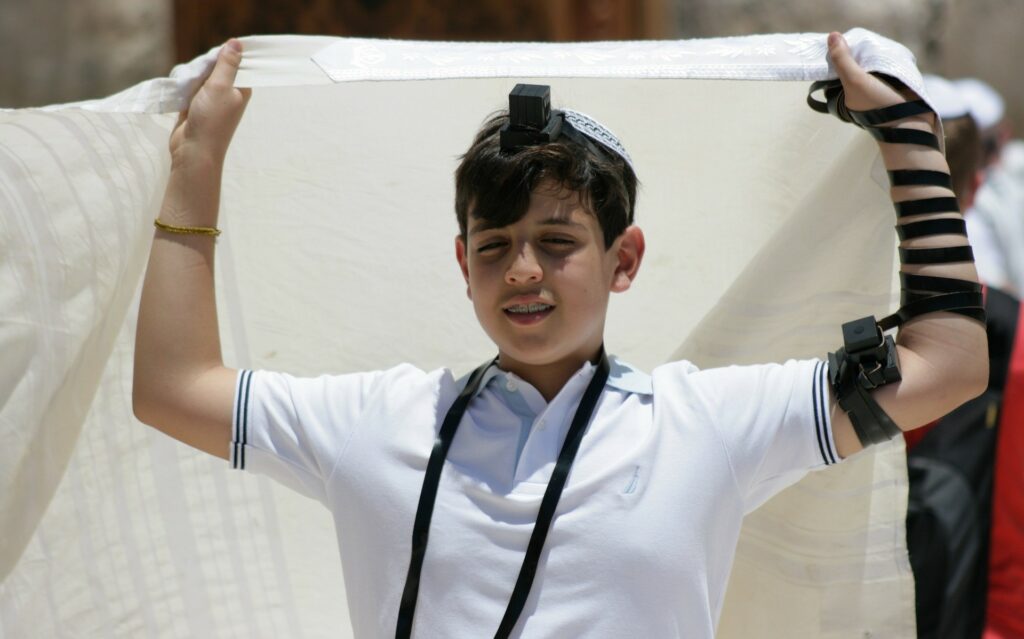
If the bar mitzvah ceremony takes place on a regular weekday, the young man will wear Tefillin. Tefillin are two small black leather boxes containing handwritten Torah scrolls, bound to the arm and head with leather straps.
The commandment to wear Tefillin applies only to Jewish adults. The physical act of binding the box to the bicep (facing the heart) and the head (over the brain) represents the young man dedicating his emotions, his actions, and his intellect to God. When he wraps his newly purchased, kosher Tefillin for his bar mitzvah ceremony, he is physically binding himself to the covenant of his ancestors.
The D’var Torah: A New Voice
Toward the end of the bar mitzvah ceremony, the young man will typically deliver a speech known as a D’var Torah (Word of Torah). This is not just a moment to thank his parents and the guests for coming. The core of the D’var Torah is an intellectual analysis of the week’s Torah portion.
By analyzing the ancient text and applying its lessons to modern life, the young man claims intellectual ownership of his heritage. For the first time, the community sits back and learns from him. He has transitioned from a student of the community to a teacher.
The Symbolism Behind the Joy
While the bar mitzvah ceremony is a solemn and sacred rite of passage, it is also infused with explosive joy and celebration. The community’s reactions during the service are rich with meaning.
The Shower of Candy
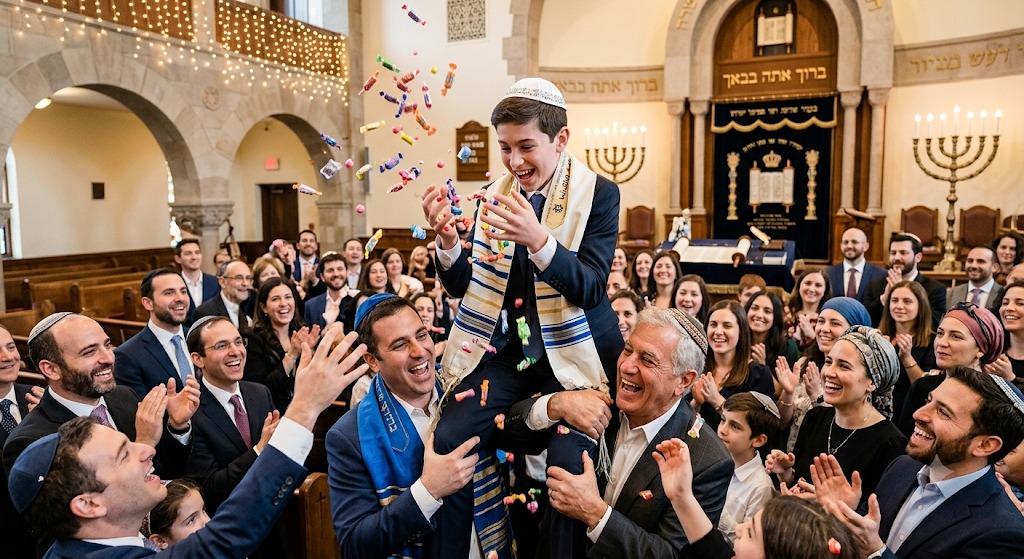
As soon as the young man concludes his final Haftarah blessing, the synagogue often erupts in a shower of flying candy. Congregants toss soft, kosher candies at the bimah, accompanied by joyous singing of “Mazel Tov!”
This sweet tradition is highly symbolic. The physical shower of sweetness represents the congregation’s collective wish that the young man’s transition into adulthood, and his future life, will be filled with sweetness, joy, and the blessings of the Torah.
Counting in the Minyan
Another critical, yet subtle, meaning of the bar mitzvah ceremony is the young man’s inclusion in the minyan. A minyan is a quorum of ten Jewish adults required to recite certain communal prayers, including the Mourner’s Kaddish and the public reading of the Torah.
Before his 13th birthday, the boy did not count toward this number. Now, his presence matters in a highly tangible way. If there are nine men in the room, they cannot pray as a full community. When he walks in, he becomes the tenth. He makes the community whole. This teaches him that his presence is vital; the Jewish people literally need him in order to function.
The Preparation: A Journey of Character
It is impossible to discuss the meaning of the bar mitzvah ceremony without acknowledging the grueling, transformative preparation that precedes it. A bar mitzvah is not something a young man can simply show up for; he must earn his moment on the bimah.
This preparation often takes a full year of intensive study with a rabbi or cantor. It requires discipline, focus, and the sacrifice of his free time. By grappling with ancient Hebrew texts, he learns perseverance.
Additionally, modern bar mitzvah preparation almost always includes a “Mitzvah Project.” Recognizing that becoming an adult means taking responsibility for the welfare of others, the young man will spearhead a charitable initiative. Whether he is raising funds for an orphanage in Israel, volunteering at a local food bank, or organizing a clothing drive, the Mitzvah Project grounds the spiritual ceremony in practical, world-changing action. It proves that he understands the core meaning of being a “Son of the Commandment”: that faith requires action.
What the Ceremony Means for Family and Guests
For the parents, grandparents, and guests sitting in the sanctuary, the bar mitzvah ceremony evokes a deeply emotional response. It represents the ultimate triumph of Jewish continuity, a concept known as L’dor V’dor (From Generation to Generation).
Judaism has survived centuries of exile, persecution, and assimilation. Every time a 13-year-old boy steps up to the Torah and chants the exact same Hebrew words that his grandfather, his great-grandfather, and his ancestors thousands of years ago chanted, he is defying history. He is proving that the chain remains unbroken.
When guests attend a bar mitzvah ceremony, they are not just witnessing a coming-of-age ritual; they are actively participating in the survival and flourishing of the Jewish people. It is a moment of profound collective pride.

Frequently Asked Questions About the Bar Mitzvah Ceremony
How long does a typical bar mitzvah ceremony last?
The length of the ceremony depends entirely on the community and the day of the week. A Shabbat (Saturday) morning bar mitzvah ceremony in a traditional synagogue typically lasts between two to three hours, as it is embedded within the full weekly Sabbath service. A weekday ceremony (such as on a Monday or Thursday) is usually much shorter, lasting about 45 minutes to an hour.
Can a bar mitzvah ceremony be held on any day of the week?
A bar mitzvah ceremony that includes a Torah reading can only be held on days when the Torah is traditionally read during the morning service. This includes Shabbat (Saturday), Mondays, Thursdays, Rosh Chodesh (the first day of the Jewish month), and major holidays. Saturday morning remains the most popular and festive choice.
Do you have to read from the Torah during the bar mitzvah ceremony?
Technically, no. A boy becomes a Bar Mitzvah automatically when he turns 13, regardless of whether a ceremony takes place. While chanting from the Torah and Haftarah is the universally accepted tradition to mark the occasion, a boy with special needs, or one who did not have the opportunity to study, can simply be called up for an Aliyah (reciting the short blessings over the Torah) to fulfill the ceremonial requirement of his new status.
What is the role of the parents during the bar mitzvah ceremony?
The parents play a highly emotional and supportive role. Traditionally, the parents are also called up to the Torah for an Aliyah. The father (and in liberal communities, both parents) recites the Baruch She’ptarani blessing, officially transferring spiritual responsibility to the son. Parents also frequently deliver a short, heartfelt speech expressing their pride and offering blessings for their son’s future, and they host the Seudat Mitzvah (the festive celebratory meal) following the service.
Are non-Jews allowed to attend a bar mitzvah ceremony?
Yes, absolutely! Non-Jewish guests are warmly welcomed and highly encouraged to attend the bar mitzvah ceremony. Synagogues are houses of worship open to all respectful visitors. Non-Jewish male guests are typically asked to wear a kippah (skullcap) as a sign of respect. However, they are not expected to wear a tallit (prayer shawl) or know the Hebrew prayers. Your presence to support the young man is what matters most.
Sources
Classical Philosophy & Rabbinic Thought
- Sefer HaChinuch (The Book of Education), Mitzvah 73 – A foundational 13th-century text detailing the philosophical reasoning behind the commandments and the transition into adult obligation.
- Rabbi Samson Raphael Hirsch, Horeb: A Philosophy of Jewish Laws and Observances – Insightful 19th-century commentary on the psychological and spiritual development of a Jewish youth entering adulthood.
- Midrash Rabbah (Genesis Rabbah 63:10) – The ancient midrashic source explaining the transition of responsibility at age 13, using the biblical narrative of Esau and Jacob as the historical precedent.
Halachic & Liturgical Sources
- Kitzur Shulchan Aruch (The Abridged Code of Jewish Law) – Clear, accessible rulings detailing the laws of an Aliyah, the minyan requirement, and the structure of the morning Torah service.
- Magen Avraham on Orach Chaim 225 – The authoritative commentary detailing the requirement and profound meaning behind the father’s recitation of the Baruch She’ptarani blessing.
Modern Cultural & Historical Context
- Union for Reform Judaism (URJ.org) – Contemporary guides on the evolution of the Bar Mitzvah ceremony in modern America. Topics include the inclusion of the D’var Torah and the Mitzvah Project.
- Jewish Literacy by Rabbi Joseph Telushkin – A comprehensive modern overview of the historical development of the Bar Mitzvah from a simple Aliyah into the complex, joyous ceremony we celebrate today.