


The art world lost one of its great innovators this week. Yaacov Agam, the Israeli artist who transformed movement into art, passed away on June 21, 2026, at the age of 98.
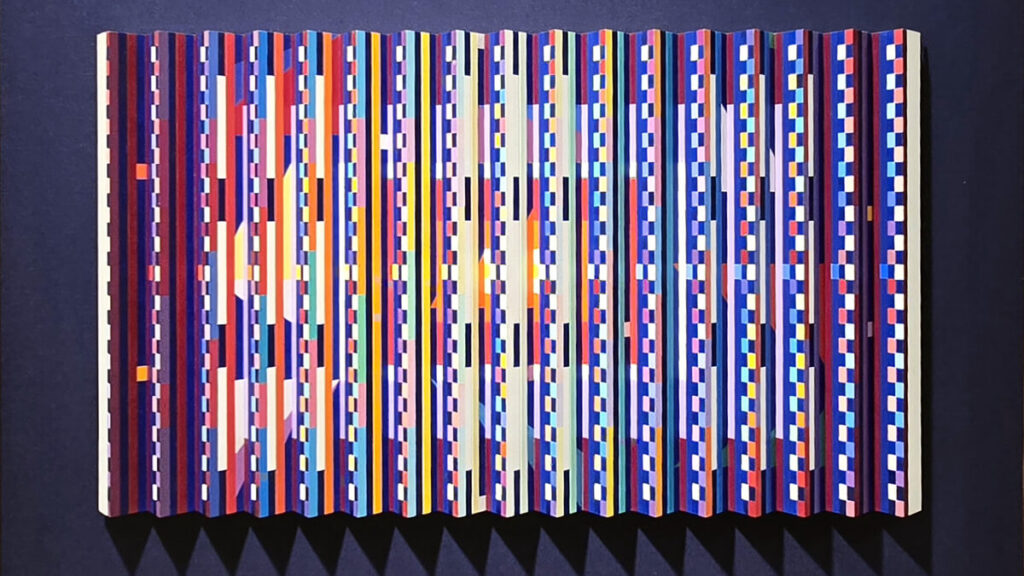
For more than seven decades, Agam created artworks that refused to stand still. Walk past one of his paintings and the image changes before your eyes – colors shifting into new colors, one picture dissolving into another, the entire surface coming alive through the viewer’s movement.
Only weeks before his passing, Agam received the Israel Prize, Israel’s highest civilian honor, recognizing a lifetime of artistic achievement. He leaves behind a remarkable body of work that, fittingly, will continue to change with every new viewer.
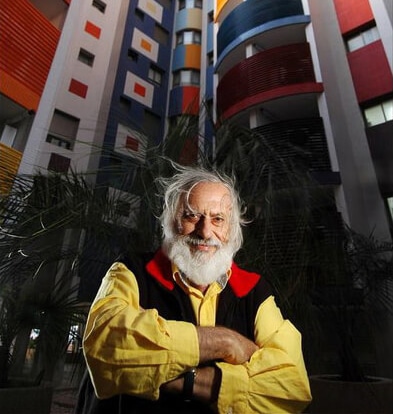
The Father of Kinetic Art
Agam is usually called the father of kinetic art – art built around motion, whether the artwork itself moves or the viewer does. His breakthrough was showing that a painting doesn’t have to be a single, fixed image. By painting different compositions on angled surfaces, he created works that transformed as you walked past them. He often insisted that the viewer was not a spectator but a participant, even a kind of collaborator – the work was not finished until someone moved in front of it.
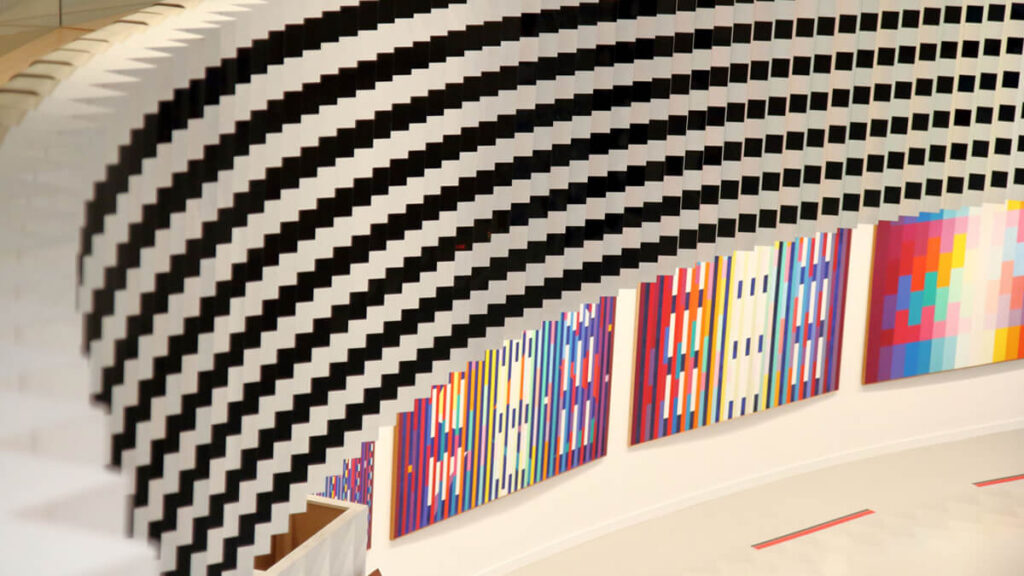
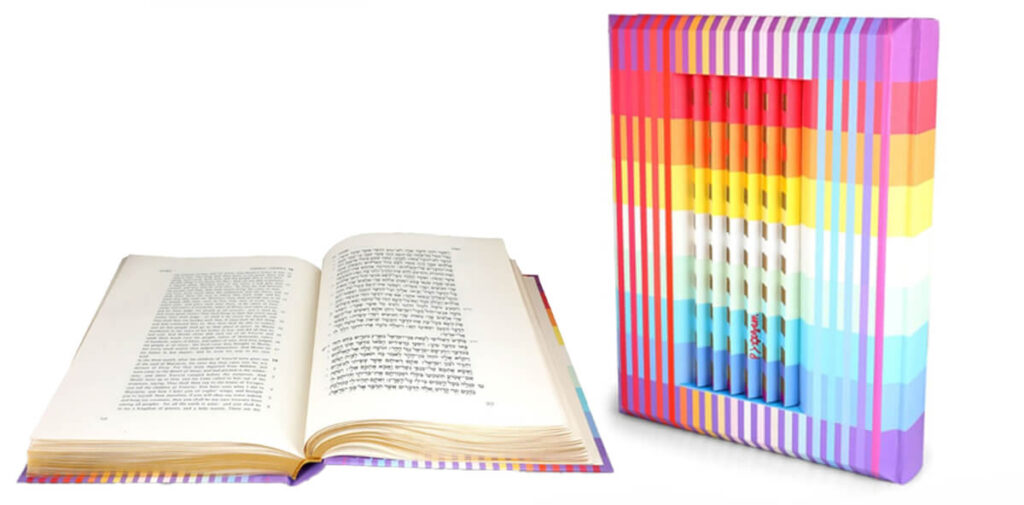
Many people have encountered Agam’s work without realizing it. His best-known invention is the Agamograph – a print that changes image as you move past it. You may have seen the effect on novelty postcards, but Agam transformed the concept into serious art, and he was the first to do so.
His phrase for the principle behind all of it was “perpetual becoming.” He believed reality is never fixed – that things are always in the middle of turning into something else – and he wanted his art to behave the same way. A picture you can exhaust in a single glance, he thought, tells a lie about the world. A picture that withholds part of itself, that asks you to move and look again, tells the truth.
From Rishon LeZion to Paris
Born Yaacov Gibstein in Rishon LeZion in 1928, Agam grew up in a deeply religious home. His father was a rabbi and kabbalist, and although his art would become increasingly abstract, its spiritual roots never disappeared. As a teenager, he was among those arrested by the British during the 1946 “Black Sabbath” operation and spent several months in a detention camp. After studying at the Bezalel Academy in Jerusalem, he moved to Zurich, where he absorbed the rigorous color theory of the Bauhaus teacher Johannes Itten, before settling in Paris in 1951. The French capital remained his home for the rest of his life.
Success came early. In 1953, Agam staged what is widely regarded as the world’s first solo exhibition composed entirely of moving artworks. Two years later, he found himself exhibiting alongside Marcel Duchamp, Alexander Calder, and Jean Tinguely in the landmark Paris exhibition that announced kinetic art to the world. Agam was still in his twenties, but he was already one of the defining figures of a new movement.

At first glance, Agam’s art seems to stand in tension with Jewish tradition. After all, the Second Commandment warns against making graven images, a prohibition that has shaped Jewish attitudes toward art for centuries. Yet Agam drew the opposite conclusion. If no image can truly capture the divine, perhaps the answer is to make images that refuse to be fixed: abstract, shifting, never resolving into a single, settled form.
Agam often described his works as “visual prayers.” He believed creativity lay at the very heart of Judaism and that reality itself is always in motion, always becoming. It was an unlikely combination: the Jewish mysticism of his childhood and the rigorous discipline of the Bauhaus. Yet in Agam’s hands, the two came together with remarkable harmony.
A Legacy Still in Motion
That vision extended far beyond the gallery. Agam’s public commissions became some of the world’s most recognizable works of kinetic art, from the Fire and Water Fountain in Tel Aviv’s Dizengoff Square to the monumental fountain at La Défense in Paris and the towering Hanukkah menorah on Manhattan’s Fifth Avenue, recognized as the largest in the world.
You don’t have to visit a museum to encounter Agam’s art. He designed the trophy for the 1999 Eurovision Song Contest in Jerusalem and developed the Agam Method, an early-childhood visual education program later honored by UNESCO. His work also made history at auction, where he became the highest-priced Israeli artist ever sold.
In 2018, his hometown of Rishon LeZion opened the Yaacov Agam Museum, devoted entirely to his work and, as Agam liked to point out, the world’s only museum dedicated to art in motion. It was there, surrounded by the creations of a lifetime, that he received the Israel Prize this spring – just weeks before his passing.
It is strange to write a fixed account of a man who spent his career insisting that nothing is fixed. Agam would probably have objected to the obituary form itself – too final, too still.
For his art tells a different story. Most artworks ask only to be looked at. Agam’s ask to be walked around, returned to, completed anew by every viewer. In that sense, his creativity lives on. His creations are still waiting for the next person to set them in motion.
Top image: Fire and Water Fountain, Dizengoff Square, Tel Aviv (2012). Photo by Silvia Mollova, via Wikimedia Commons. Licensed under CC BY-SA 3.0.
For more information about our research process, sourcing, and editorial review, please see our editorial standards and content policy.