

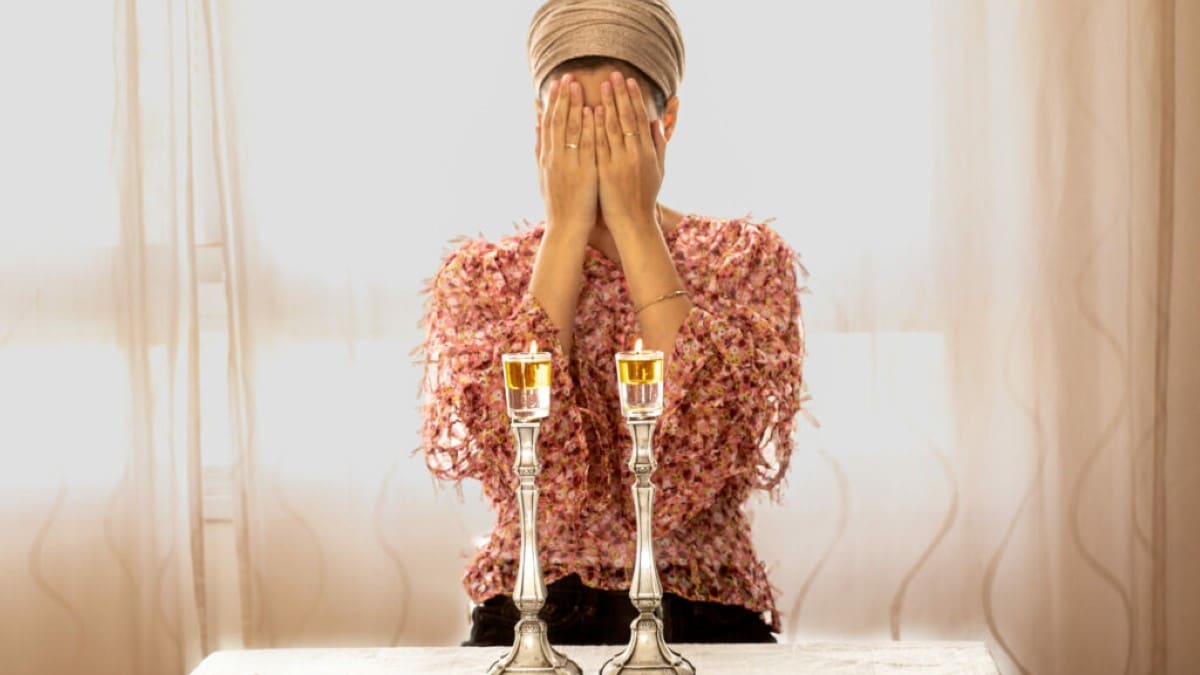
Shabbat candle lighting (hadlakat nerot) is the rabbinic mitzvah of kindling lights before the onset of Shabbat, observed every Friday before sunset. For generations, the lighting of the candles shabbat has marked the definitive boundary between the mundane, hurried workweek and the peaceful sanctuary of the holy day.
As the sun begins to dip below the horizon on Friday afternoon, a quiet hush falls over the home. Striking a match and kindling these beautiful jewish shabbat candles transforms the atmosphere entirely, bringing a tangible sense of warmth, calm, and sanctity into the dining room.
Whether you are exploring this beautiful tradition for the first time or you have been observing the sabbath candle lighting for decades, this comprehensive guide will walk you through the rich halachic framework, the deep spiritual meaning, and the practical steps of this beloved practice.
1. Where Does the Mitzvah of Shabbat Candle Lighting Come From?
2. Who Performs Shabbat Candle Lighting?
3. How Many Candles?
4. When to Light
5. How to Light – Step by Step
6. The Shabbat Candle Blessing
7. The Moment of Prayer
8. Candles, Oil, or Electric?
9. Lighting Away from Home
10. Frequently Asked Questions
Where Does the Mitzvah of Shabbat Candle Lighting Come From?
Interestingly, the mitzvah is rabbinic, not biblical, there is no explicit commandment to light candles in the Torah. Instead, the Talmud (Shabbat 25b) establishes it as one of the primary mitzvot associated with Shabbat. The original form of this mitzvah was fulfilled with oil lamps, not candles. In fact, the Talmud dedicates significant discussion to exactly which oils and wicks are suitable to ensure a clear, steady flame.
Over the centuries, wax candles became the widespread practice simply because they were much more accessible and practical than liquid oil. Because the blessing refers to kindling the “ner shel Shabbat“, the Shabbat light, and not specifically to wax candles, oil lamps and even electric lights are halachically valid under certain circumstances.
The sages outlined three primary reasons for the mitzvah: kavod Shabbat (honoring Shabbat), oneg Shabbat (the pleasure and joy of Shabbat), and shalom bayit, peace and harmony in the home. The Talmud’s explanation of shalom bayit is disarmingly practical and delightfully human: without light, people stumble, bump into furniture, and are forced to eat their festive meals in the dark, and a household that eats in the dark is not a peaceful one!
Two thousand years later, even with modern electricity, this logic still holds beautifully; the dedicated light of hadlakat nerot (the lighting of the candles) creates an environment of focus, serenity, and domestic tranquility.
Who Performs Shabbat Candle Lighting?
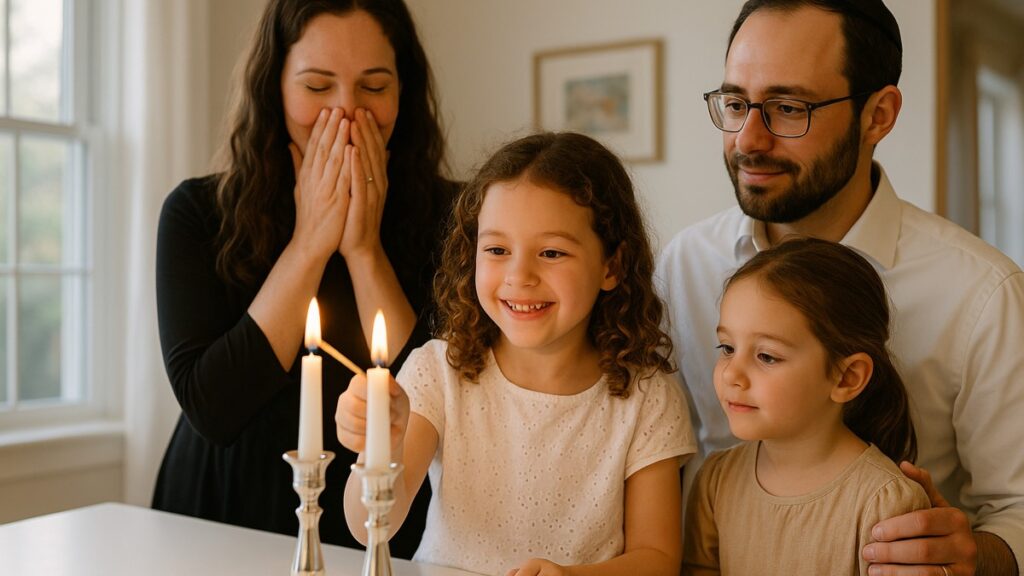
Who lights shabbat candles? The Rambam (Hilchot Shabbat 5:3) and the Shulchan Aruch (O.C. 263:3) rule that both men and women are obligated in this mitzvah, but women take precedence because they are traditionally the ones who bring Shabbat into the home.
This profound act of Jewish candle lighting is primarily associated with the Akeret Habayit (the foundation of the home). Consequently, the iconic image of a woman lighting shabbat candles has become the enduring symbol of welcoming the Sabbath.
In practice, the wife lights for the entire household, and a husband fulfills his own obligation through his wife’s lighting. However, a man who has no woman lighting for him, such as a bachelor, a widower, or a husband whose wife is away for the weekend, is fully obligated to light the candles himself.
Unmarried women living away from home are obligated to light in the space where they eat. The rules shift slightly if you are a guest at someone else’s home: if you are eating with the host family, the host’s lighting technically covers the guest.
If the guest has their own room and eats separately, they must light with a bracha. Despite this, there is a widespread minhag (custom) for married women to light their own candles even as guests in someone else’s home, though this is a common custom rather than universal halacha. (These distinctions are based on the Shulchan Aruch O.C. 263:6).
How Many Candles?

How many candles do you light for shabbat? The baseline requirement is two candles, corresponding to the two distinct formulations of Shabbat found in the Torah: Zachor (remember) and Shamor (guard). The Shulchan Aruch (O.C. 263:1) codifies this two-candle minimum as the accepted practice for all Jewish homes.
However, the light in a Jewish home often grows alongside the family. Many women add one candle for each child born into the family. Once this is established, it becomes the permanent minhag and should not be changed.
Some families have the custom of lighting seven candles, corresponding to the seven days of the week, while others light ten, corresponding to the Ten Commandments. These larger numbers are not tied to any specific community; all of these variations are halachically acceptable.
When a woman is away from home, she who normally lights more than two candles may light just two for logistical ease. The key halachic rule, according to the Mishnah Berurah (263:6), is that once you establish a minhag for the specific number of candles you light at home, you must maintain it and not vary the number from week to week.
When to Light
What time do you light shabbat candles? The universally accepted time in most communities around the world is 18 minutes before shkiah (sunset). This 18-minute window is not a Torah law; rather, it is a rabbinic fence instituted to ensure that Shabbat is not accidentally desecrated by lighting fire too close to nightfall.
In Jerusalem, the local custom is even stricter, requiring candles to be lit 40 minutes before sunset. Some other communities have their own specific timeframes, so you should always follow your local minhag.
If you need to usher in the Sabbath earlier, the earliest permitted time to light is plag hamincha, which is one and a quarter halachic hours before sunset. Because a halachic hour is defined as one-twelfth of the daylight period, the exact time of plag hamincha varies wildly by season and location. In practice, you should simply check a reliable zmanim app or calendar for your city.
The absolute latest permitted time is shkiah itself. After sunset, Shabbat has already officially begun, and lighting a flame is a severe halachic violation. According to the Mishnah Berurah (263:43), the afternoon prayer (Mincha) should be davened before lighting candles.
In extenuating circumstances, a woman may make a verbal “condition” (tenai) before lighting, explicitly stating she is not yet accepting Shabbat, to permit herself to do melacha (forbidden work) until sunset.
How to Light – Step by Step
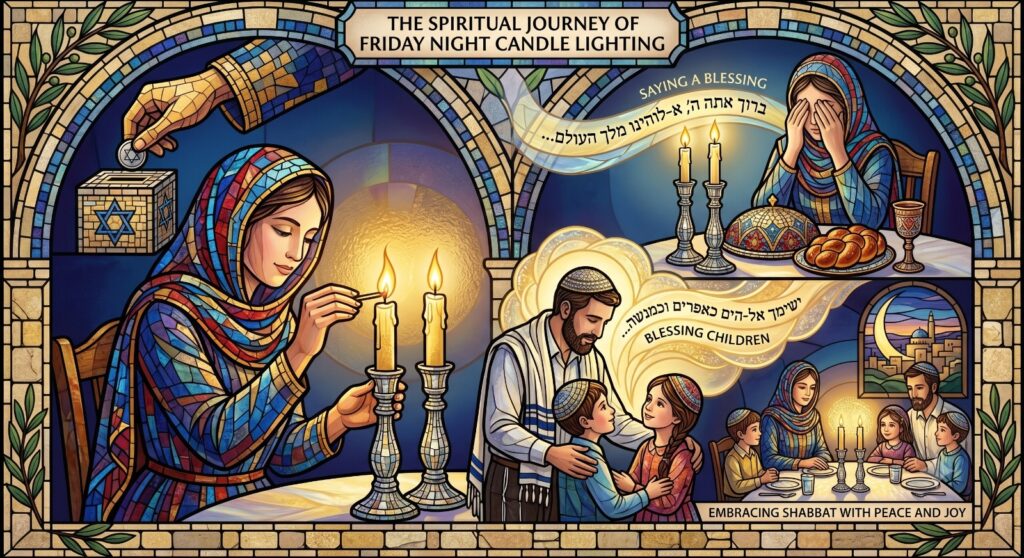
The physical act of lighting is steeped in sensory tradition and meticulous halachic preparation. To begin, the candles should be placed on or near the Shabbat table where the Friday night meal will be eaten. In some communities, the husband takes an active role in the preparation; some have the custom of having the husband pre-light the wicks and immediately extinguish them to make them easier for his wife to kindle.
Before striking the match, giving tzedaka (charity) is a highly commendable practice, as noted by the Kitzur Shulchan Aruch (72:2). Because of this, many households keep a dedicated tzedaka box right near the candlesticks.
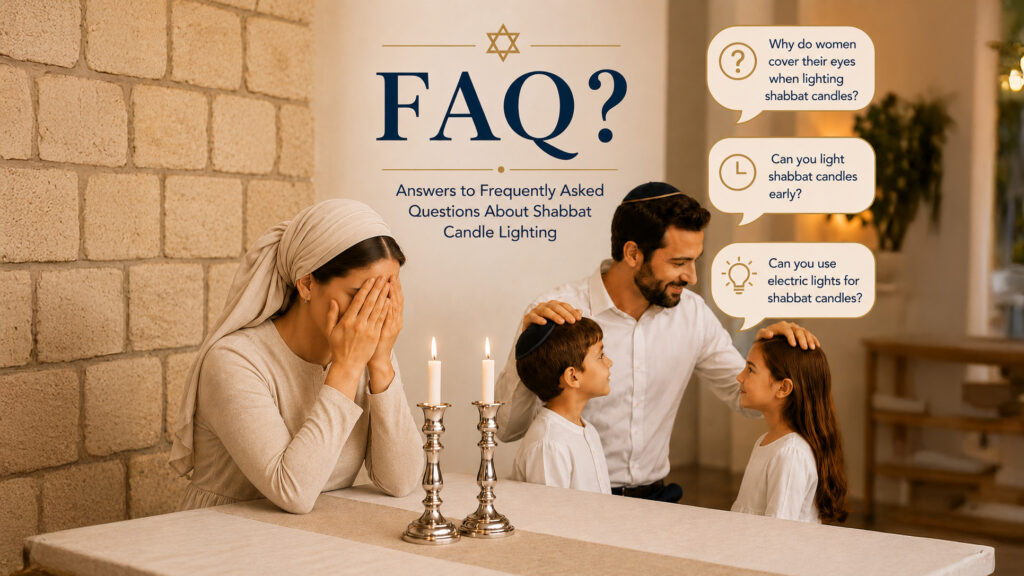
When it is time for the lighting itself, the Ashkenazi custom is to light the candles first, then cover the eyes, and finally recite the bracha. Why do women cover their eyes when lighting shabbat candles? The halachic rule is that a blessing must always precede the benefit of the mitzvah.
However, lighting the candles fundamentally means accepting Shabbat (according to most Ashkenazi authorities), after which melacha (like striking a match) is forbidden, so you cannot simply say the bracha first and then light the fire. The beautiful, lived solution to this legal puzzle is to light the candles first, cover your eyes so you do not benefit from the light just yet, recite the bracha, and then uncover your eyes to “see” the candles for the very first time as a holy light.
If you absolutely need to perform melacha (work prohibated on the Sabbath) after lighting, you must declare verbally before lighting that you are not yet accepting Shabbat. Without this explicit condition, lighting the candles constitutes automatic acceptance, and melacha is forbidden from that exact moment.
The sephardic shabbat candle lighting follows a different order. The Sephardi custom is to recite the bracha first, and then light the candles. According to Rav Ovadia Yosef (Yechave Daat 2:33) and the rulings of the Shulchan Aruch (O.C. 263:5), lighting does not automatically constitute accepting Shabbat, so the bracha naturally comes first in the usual, logical order.
The Shabbat Candle Blessing
What is the blessing for shabbat candles? Understanding the exact text is crucial to fulfilling the mitzvah. The jewish shabbat candle blessing is recited with deep concentration and joy.
The Hebrew candle blessing, transliterated below, is recited by Ashkenazi women while their eyes are covered, and by Sephardi women just before kindling the flame. The full text of the sabbath candle blessing is:
Baruch ata Adonai, Eloheinu melech haolam, asher kideshanu b’mitzvotav v’tzivanu l’hadlik ner shel Shabbat.
This beautiful shabbat candle blessing translates to: “Blessed are You, Lord our God, King of the universe, who has sanctified us with His commandments, and commanded us to kindle the light of Shabbat.”
When exploring shabbat blessings over candles, it is important to note that on Yom Tov (Jewish festivals), the ending of the blessing changes to “ner shel Yom Tov.” When Yom Tov falls on Shabbat, both endings are combined.
Immediately after reciting this shabbat candle lighting blessing and uncovering their eyes, women seamlessly transition into a deeply personal moment of reflection, which leads us to one of the most beloved aspects of this weekly ritual.
The Moment of Prayer

After reciting the bracha and uncovering the eyes, many women pause to pray silently for their families, children, and the Jewish people. While this is not a formal halachic obligation, it is a deeply rooted, fiercely protected minhag.
The halachic basis for this practice is that candle lighting creates a moment of heightened spiritual receptivity; the woman has just performed a sacred mitzvah and stands bathed in the glow of the Shabbat lights. Many rabbinic authorities strongly encourage personal prayer at this specific moment.
There are incredibly powerful prayers for shabbat candles that women have whispered for centuries. The spiritual foundation of this moment traces back to the tradition of Sarah Imeinu (our matriarch). The Midrash (Bereishit Rabbah) records that the candles in Sarah’s tent burned miraculously from one Shabbat all the way to the next.
When Rivka eventually entered Yitzchak’s tent after Sarah’s passing, the exact same miracle returned. This is not just a lovely legend, it serves as the bedrock foundation for the special status of a woman’s shabbat candle lighting as a moment of undeniable spiritual power.
The passing of these shabbat candle lighting prayers and customs from mother to daughter acts as an unbroken thread, connecting generations of Jewish women across time and continents. It is a profoundly moving experience to stand before the flickering flames, knowing that your grandmothers and great-grandmothers uttered the exact same pleas for health, peace, and spiritual light.
Candles, Oil, or Electric?
Can you use electric lights instead of candles for shabbat? To answer this, we must look at the hierarchy of permitted materials.
Oil, specifically olive oil, is actually preferred by many halachic authorities because it produces the clearest flame and represents the original, ancient form of the mitzvah, as codified in the Shulchan Aruch (O.C. 264:6) and the Mishnah Berurah. Utilizing shabbat oil candles provides a stunning, authentic connection to antiquity.
However, solid wax candles are the most widespread minhag today and are fully, undeniably valid. While white candles are traditional and visually classic, there is absolutely no halachic requirement regarding the color of the wax.
Electric shabbat candles are a modern halachic marvel. They are considered valid b’dieved (after the fact) according to most poskim, and they can absolutely be used with a bracha in strict circumstances where an open flame cannot be lit, such as in a hospital room or a hotel with a strict no-flame policy. In a famous ruling, Rav Moshe Soloveitchik permitted a bracha over electric lights for his hospitalized wife. It is critical to note that while valid in extenuating circumstances, electric lights are not equal to or preferable to a real flame; they are an alternative, not a first choice.
Regardless of the material, the duration of the light matters. The candles must burn long enough to be seen and enjoyed during the Friday night meal, minimally lasting until tzeit hakochavim (nightfall). You should always use candles rated for at least 3 hours of burn time.
Lighting Away from Home
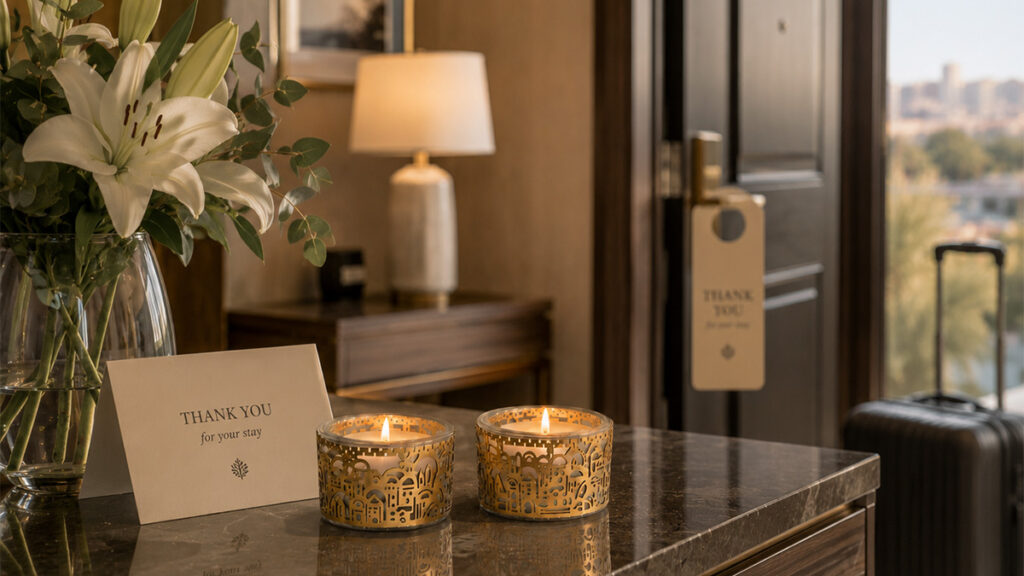
Maintaining this weekly mitzvah while traveling requires a bit of logistical planning. When staying in hotels, each family should light in the dining room or adjacent to their sleeping space with a bracha. If fire is strictly prohibited by the venue, you should use battery-operated travel shabbat candles or politely ask the hotel staff to provide a designated, safe space for your flames.
In hospitals, a woman who has recently given birth lights in her hospital room where she eats, reciting the bracha. If the hospital regulations make this entirely impossible, her husband must light at home with her explicitly in mind.
When you are staying at someone else’s home as a guest, the rules hinge on your living arrangement. If you are eating with the host family and the host is lighting, a guest may technically be covered by their flame. Nevertheless, many women maintain the beautiful minhag of lighting their own candles with a bracha regardless of the host’s lighting.
Students and women living alone away from home are obligated to light with a bracha in the dedicated space where they eat. Because the exact rules for guests and their obligation level depend heavily on whether they have a separate “dwelling space,” this can be a nuanced halachic topic; always direct specific situational questions to your rabbi.
Frequently Asked Questions
What time do you light shabbat candles?
The universal standard is to light 18 minutes before sunset, though the custom in Jerusalem is a stricter 40 minutes before sunset. If you need to bring the Sabbath in early, the absolute earliest permitted time is plag hamincha (one and a quarter halachic hours before sunset).
How many candles do you light for shabbat?
Two candles is the baseline, representing zachor and shamor. Many families add one candle per child as their minhag develops. Whatever number your household settles on, the rule is to keep it consistent week to week rather than changing it.
What is the blessing for shabbat candles?
The blessing is: “Baruch ata Adonai, Eloheinu melech haolam, asher kideshanu b’mitzvotav v’tzivanu l’hadlik ner shel Shabbat.”
It is recited after lighting in the Ashkenazi custom, and before lighting in the Sephardi custom.
Why do women cover their eyes when lighting shabbat candles?
Because a blessing is normally said before benefiting from something, but lighting the candles is considered accepting Shabbat, after which a new flame can’t be lit. Covering the eyes let’s a woman say the blessing without yet “benefiting” from the light, then uncover her eyes afterward to see it for the first time.
Can you light shabbat candles early?
Yes, you can light shabbat candles early, starting from plag hamincha onward, but absolutely not before that time. Keep in mind that lighting early early shabbat candles means you are accepting the restrictions of Shabbat early as well.
Can you extinguish shabbat candles?
No. Once you have accepted Shabbat by lighting the candles, you may not extinguish them yourself. You must allow them to burn out safely on their own.
Can you use electric lights for shabbat candles?
Yes, but only in extenuating circumstances. According to most poskim, if you are in a hospital or a hotel with a strict no-open-flame policy, using electric lights is a valid alternative and you may recite a bracha. It is not the preferred practice if an open flame is possible.
What is the prayer said after lighting shabbat candles?
There is no fixed halachic text required after lighting. However, women traditionally pray silently for the health, safety, and spiritual success of their families and children immediately after reciting the bracha and uncovering their eyes. Some women use the traditional Tefillat HaNashim or recite their own personal prayers.
Shabbat candle lighting is one of those mitzvot that takes thirty seconds and shapes the entire week around it. Whether you’ve been lighting candles every Friday for forty years or you’re setting up your candlesticks for the first time, the same two flames connect you to the same tradition every Jewish woman before you has kept. If you’re ready to bring that tradition into your own home, explore our collection of candlesticks handcrafted by Israeli artisans in Jerusalem, made to be lit, generation after generation. Order yours today and light up your Shabbat table the way it’s meant to be lit.